Every year I try to prepare myself for Christmas by embracing the Advent Season. Perhaps Advent should be a time of quiet reflection. A time for meditation and prayer. A time to quiet my soul and prepare the way for Christ’s coming into my life. But Jesus is already here. I just don’t always take the time to meet Him or possess the ability to notice anything besides myself or my needs. So, for me, Advent must be a wake-up call.
Sure, quiet, peaceful reflection is beautiful, but I sometimes need a “kick in the pants”. What better way to focus on what is important, what is necessary, than to encounter God shouting at me. “Hey, Denis!” “Pay attention!” “This message is for you!”
I need to let go of what I think is important. I need to look across the table; across the aisle; across the street; across the ocean. When I can find God in everyone and everything around me and beyond me, then I will be ready for Christmas. It’s a worthy goal. And completely overwhelming. But I can start small.
I can light a flame inside my soul. I can share that light with others through kindness and understanding. I can take time to listen, hold a hand, dry a tear, share a laugh, tend a wound or mend a broken heart.
And when I get caught up in my selfishness and lack of empathy for others, I will listen for God’s voice shouting for me. I imagine God, as my Mom, all those years ago when I was boy out playing with my friends, shouting for me to come home.
Wisdom shouts in the street, She lifts her voice in the square; At the head of the noisy streets she cries out; At the entrance of the gates in the city she utters her sayings. Proverbs 1:20-21
Come home! And then I can light the Advent wreath. One flame at a time…
In his book, Julian of Norwich: Wisdom in a Time of Pandemic and Beyond, Matthew Fox quotes Julian, a 14th century mystic: “Those who were Jesus’ friends suffered because they loved Him”. Fox then adds in his own words, “It hurts to be with the pain of others, of loved ones. But it also grows the soul.”
This week we celebrated the life of my cousin Michelle who passed away on October 7th. Michelle was a gentle soul who accepted every one of us as we were. I never heard her speak ill of anyone. She dearly loved animals because the love they returned to her was unconditional. Her life was not always easy but she carried joy in her heart and she shared that joy with all who encountered her, especially her furry and feathered friends.
When I think of Michelle I am reminded that Saint Francis, who also had a gentle nature, believed that humans and animals could live in loving harmony. Francis is attributed as saying, “My brother birds, you should greatly praise your Creator, and love Him always. He gave you feathers to wear, wings to fly, and whatever you need. God made you noble among His creatures and gave you a home in the purity of the air so that though you neither sow nor reap, He nevertheless protects and governs you without your least care.”
Michelle’s service was beautiful and spending time with her siblings and her mother “grew my soul” this week. Our family, of which 4 or 5 generations have lived in the same town, is now spread throughout the rest of the world like many families today. There was comfort in being in our hometown and laying Michelle to rest next to her father, with those other 4 generations nearby. Knowing that we belong to those who came before us is comforting and grounding. Knowing that we belong to those who remain with us gives me strength. We shared our grief and our heartache on Monday but we shared our joy and our love for one another as well. This is our tribe and we carry one another when necessary. I held my cousin Kim’s hand as we prayed and watched Michelle’s remains be interred. That simple gestured calmed my soul and lifted my spirit. We are family and we belong to one another in a way no one else can.
Michelle had many gifts. She was a talented artist. She was generous to a fault. She didn’t have a pretentious bone in her body. She never met a stranger and welcomed all strays (even the two legged kind). But most importantly, to me, the greatest gift she possessed was simply this: every time I saw her I always left feeling better. Tomorrow when I am giving thanks, I will thank God for Michelle and for allowing my soul to grow. And I pray that she is flying in the purity of the air in heaven and smiling down on all of us.
Peace,
Denis
“Lord, make me an instrument of your peace. Where there is hatred, let me sow love; where there is injury, pardon; where there is doubt, faith; where there is darkness, light; and where there is sadness, joy.” ~ Saint Francis
Today is the Feast Day of Saint Denis. He is the patron Saint of Paris and France and headache sufferers. Feast days in the Church seem archaic and arcane. Perhaps that’s why I like celebrating them. They’re a reminder that our Church is ancient and mysterious and somehow still enduring.
St. Denis – Outside the Madeline in Paris (depicted with head intact)
I’ve always been happy to have Denis as my saint’s name because he’s kind of a maverick and a tough guy. According to legend Denis was Bishop of Paris in the third century and was martyred by beheading. He is said to have picked up his own head and walked six miles, preaching a sermon the entire way. Besides being the patron saint of headache sufferers (for obvious reasons), Denis is also the patron saint of people dealing with frenzy and strife. During this time of pandemic we might learn something from Denis and “keep on keepin’ on”.
Of course, I admire the “saintly” saints who prayed and fasted and gave up all worldly possessions to follow Jesus’ call. We all love the saints who lived simple lives and made tremendous sacrifices for their faith but there’s something about a guy who has Denis’s spunk. I mean even the biggies like Francis and Theresa and Patrick and Clare didn’t carry around their own heads postmortem. So, in my book Denis is a saint to emulate. Not only was he tough but he was cool. Let’s call it grace under pressure – extreme pressure.
My Aunt Gene Marie used to send me a ‘Saints Day’ card on Denis’s feat day and I will miss that again this year, but I believe she’s in heaven now discussing that fateful day in Paris with Saint Denis and still celebrating his feast day. She’s the one who first introduced me to the saint who shares my name. I have always taken a certain amount of pride (is that a sin?) in the fact that my patron saint was a badass who defied his Roman persecutors!
I’ll keep celebrating feast days amidst the growing uncertainty about the future of our Church. When we forget that love should be our guiding principal and we refuse to accept ALL of our brothers and sisters, I believe that we are turning our back on God. Julian of Norwich, a 14th century mystic, wrote, “God is all that is good. God has created all that is made. God loves all that he has created. And so anyone who, in loving God, loves all his (or her) fellow creatures.” Julian was a woman who lived during the bubonic plague and still found joy in all creation. I am comforted by the knowledge that our Church is ancient and universal and that Julian’s wisdom still speaks to me today. I wish all clerics would read her words. We continue to make mistakes; to exclude; to blame; to punish. How many times in history have men nearly undone the gift of Church that God has given us? I wish all Christians would remember that we are the Church. I believe that there is room at the table for all of us. We can honor those who have come before us and thank God for the wisdom they have shared. We can pray for those who will follow us and show them that love is never a mistake.
A feast day is as good a time as any to do both. Jesus loved saints and sinners. And He still does.
Peace,
Denis
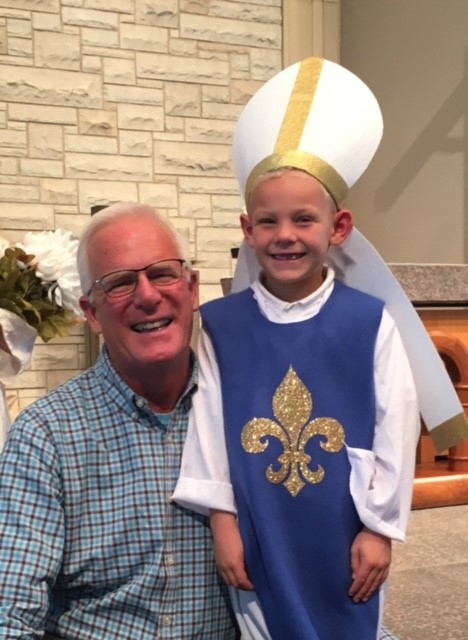
A few years ago my grandson was Saint Denis at his school’s annual All Saints’ Day celebration. If pride really is a sin then I’m surely doomed.
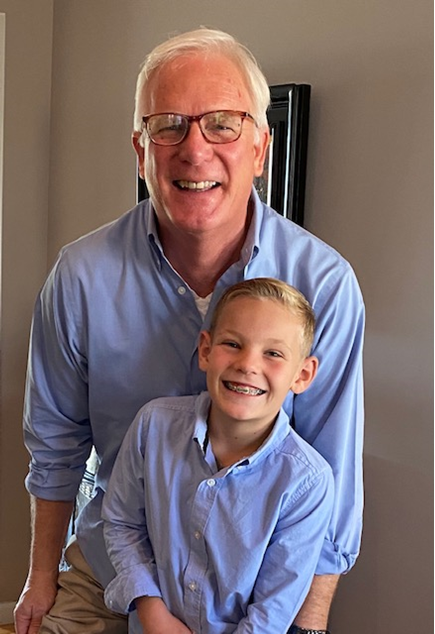
Eleven years ago he stole my heart and conquered my world. He single-handedly restored my faith in God. He gives me hope for our future. It doesn’t hurt that he’s kind of my mini-me as well. We look a little bit alike (okay, more than a little bit). We laugh at the same jokes. We love the same folks. We like the same food. And we like being together.
I suppose that most men are just little boys at heart and with Noah, I can celebrate my inner 11-year-old. We both like to win at card games, contests, feats of strength, riddles, etc. No, I don’t let him win. Yes, he usually beats me.
Noah loves to point out our similarities: eye color (although his are bluer); hair color (although mine is whiter). We’re both color-blind (something that he thinks is sort of cool). Blue is our favorite color because it’s a color we can see. He looks up to me. And I’m his biggest fan.
There’s an awesome responsibility when someone sees you as a role model. What I say and do in his presence matters. My opinions, my actions are being observed and studied and often mimicked. If I act like a jerk, he might as well. If I behave with compassion, he might too. If I am patient and kind, loving and generous, he might follow that example as well. It’s tricky, this business of being a responsible adult.
Lately I find myself following his lead. He, in many ways, has become my role model. When we are together we share our stories – mine of days of old; his of school, soccer, baseball, robotics, and electronics beyond my understanding. We connect both physically and spiritually. He believes in God and I truly see God in him.
Noah has a habit of sitting next to me and taking my old arm and wrapping it around himself. That small gesture is sublime! It soothes my soul and calms my spirit. The fact that an 11-year-old boy still wants my embrace is a nothing short of miraculous. It’s my little bit heaven on earth and it will sustain me beyond the years when he no longer needs me. But I pray (selfishly) that he will always need me. Because Noah strengthens me. He makes me a better man.
Noah is eleven. He’s my boy. But in the blink of an eye he will be twenty-two. And thirty-three. And forty-four. And…
More selfish prayers – I hope that I am around to see the man that I know he is destined to become. I know that he will change our world. He’s already changed mine.
My birthday wish for him is that he will always know how much he is loved. And that he will always know I have felt his love and God’s presence whenever we are together.
Merriam-Webster tells us that to be transfigured means, “to change a thing into a different thing.” In today’s Gospel we hear of Jesus’ transfiguration. Peter, James and John witnessed with astonishment Jesus together with Moses and Elijah. It’s fitting that this reading comes to us during Lent. This is our time to be transfigured.
I don’t suppose my clothes (or yours for that matter) will become dazzling white. I also don’t expect you or I to be seated with Moses or Elijah. But we can be transfigured. We can change into something different, into someone different. I can use this time during Lent to change my heart.
My dear friend Mary sent me a simple but beautiful message this past week: “Fast from anger, and be filled with patience”. Simple and profound but not easy. Not easy for me because I like to hold on to my anger. I need my indignation. That anger can sustain me; it can justify my intolerance. That anger can empower me; it can make my hatred seem righteous.
But that anger can also destroy me; it can steal my soul; it can sap my spirit. It can become part of who I am.
The story of the Transfiguration in Mark’s Gospel is a foreshadowing of Jesus’ death and resurrection. But did his disciples really have any clue about what they had witnessed? Were they as confused about Jesus’s impact on their lives as I often find myself? Jesus is a good guy and he’s all about love and forgiveness. I love his parables. I am amazed by the miracles he performed. I am in awe of his acceptance of everyone, even sinners like me. But he’s also God. When I meditate on the Transfiguration of Jesus, I realize that my future is in his hands and I need to surrender. I need to let go of my pride and anger and hate. I need to be different. I need to be transfigured. I need to be a better man.
So during this Lenten journey I will try to change into someone different. I will try to “fast from anger”. And when I fail (which is likely), I will try again because my God is the God of second chances. And third and fourth and…
Peace,
Denis
Jesus took Peter, James, and John and led them up a high mountain apart by themselves. And he was transfigured before them, and his clothes became dazzling white. Mark 9:2-3
Our youngest child is named Blake, which originates from Old English and means ‘the fair one’. It was a good fit for the blondest of his dark-haired mother’s three children. Geneticists tell us that dark hair is a dominant trait, but my beautiful brunette wife kept popping out blondes.
Anyway, being born blonde was only the beginning of a lifetime of anomalous characteristics that define our beautiful blue-eyed baby boy. Blake was the sweetest and most demonstrative of our children but also the quickest to lose his temper. He was the most curious and restless of our brood, and therefore the most likely to disassemble lamps and small appliances, but he was capable of tremendous patience and compassion with classmates who were unpopular. He was a ‘gifted’ student and a discipline problem. Too much going on in that little head of his to sit still and listen to a teacher, I suppose. At an early age he displayed a very mature sense of humor with a healthy dose of sarcasm thrown in (this really perplexed those teachers – especially the dull ones). He questioned EVERYTHING and often resisted organized religion as a boy but was (and still is) the most profoundly spiritual of our three.
Life with young Blake was like being on a roller-coaster. The highs were high and the lows were low but that ride was a hell of a lot of fun!
The teenage years brought their own set of challenges, and it seemed at times that Blake might need to find a new home. Some of our fights were monumental. Tempers flared. Accusations and threats were made. Ultimatums were handed down. Our home at times felt like a battlefield. An added challenge was remaining our son’s advocate when teachers and professionals labeled him, and we nearly gave up and gave in. The problem boiled down to this: How could we ‘outsmart’ a kid who was clearly smarter than us?
Therapy helped. Prayer helped more. And love (which is prayer in action) was always plentiful. We stopped expecting Blake to be like his siblings or anyone else for that matter. Oh, and we learned to not sweat the small stuff. Turns out most of the “stuff” is pretty small anyway. We didn’t object when he came home with his hair dyed bright green. My response was just, “Well actually blue is my favorite color but it’s your hair…” We didn’t freak out when he wasn’t accepted into the National Honor Society (even though he was a National Merit Semifinalist). Apparently hurling an F-bomb at an assistant principal disqualifies you for that sort of thing. When he casually asked us one evening over dinner to start calling him ‘Hank’ our only question was why? His response: “I like the name.” And so, it was. We called him Hank. For the better part of a year, he became Hank. It was really no big deal, and we just decided to roll with it.
During ‘The Year of Hank’ he remained as academically gifted and artistically brilliant and maddeningly headstrong as ever but somehow the challenges became fewer; the fights were less intense. After a year or so of being Hank, he seemed bored with the novelty and became Blake once more. He recently told a friend that we were cool parents because we let him be Hank for a year. It occurred to me that we never ‘let him’ do anything. We usually stood in amazement as he was Blake or Hank and did whatever he ‘needed to do’, and we desperately tried to understand or catch up. Or give up.
He’s a grown man now but I still spy a glimpse of Hank now and then; in his voice; in his smile; in his compassion; in his sense of fairness and justice; in the way he loves with complete abandon; in his authenticity; in his loyalty.
I thank God for the ‘Year of Hank’ and the grace that allowed it to happen. If we’re all made in God’s image, heaven must be a hell of lot of fun or at least it will be when Blake arrives someday!
Peace,
Denis
When God created human beings, he made them in the likeness of God. Genesis 5:1
Maybe it’s a senior moment because it happens more often as I get older. I start to walk into a room for some reason and then almost immediately I can’t remember why. So I stop and return to where I started, hoping to trigger whatever thought it was that made me enter into that room to begin with. I suppose it’s good exercise but not really all that productive . Or perhaps I’ve lost something and I return to where I remember last seeing it. I literally retrace my steps to see if I might discover where the item was misplaced. “Where did I put my glasses?” is a common theme for me.
It’s human nature, I suppose, to want to hang on to those necessary thoughts and those necessary things. I need to know where I’m going and why. And I need my glasses to see whatever it is I’m going to be doing when I get there.
But Jesus asks us to let go. Lent is a usually thought of as time to give up something. This year, during this pandemic, even more so. What I really need to give up is my need for control. This is easier said than done. As I am struggling to wrap my head around Covid-19 and all of the repercussions of this deadly virus, I feel that I need whatever control I have left. During a normal Lenten Season surrendering to God’s plan is challenging. This year it is downright frightening. What is happening??!! Jesus, how can I let go??!!
In his book, “How Big Is Your God?”, Paul Coutinho writes “a consequence of my life with God is essentially a dying, a giving up, and a self-emptying.” He goes on to say, “Jesus promised to give us inner freedom, joy, and happiness that no one and nothing can take away from us, even in the midst of tremendous pain, suffering, sickness, and death.”
What holds me back? The challenge is thinking about what I need to leave behind.
Is it comfort? Is it fear? Is it pride? Is it hate? Is it anger? Is it anxiety? Is it my need for perfection? Is it my self-righteousness?
The frightening part is the actualleaving behind.
The strain of having to distance myself from my loved ones. Worry for our son who has lost his job in the restaurant industry. The constant concern for my 93 year-old father and 88 year-old father-in-law who are both at high risk. Dealing with the disappointment of cancelled events. Frustration with the lack of leadership in our state and in our nation. Struggling with the uncertainty of my employment. Trying to ignore the foreboding feeling of “who might be next?”. The nearly constant reassurances of “we’ll be fine”, that I both give and receive, which seem grossly inadequate.
And yet, I have to let it go. I have to leave it all behind. How else can I empty myself and wholly embrace the desert experience?
This is exactly why I need Lent. Especially this year. Maybe my journey is meant to be a struggle. A challenge. A reminder that God loves me as I am: worried; woefully unprepared; hopeless; helpless; vulnerable.
We are made in God’s image, but our humanity requires that we accept and even embrace our limitations and our sinfulness. We must accept the fact that because we have free will, we can choose to love God or not. Faith is a choice. Lent should be an opportunity not a burden.
Coutinho talks about how once we let go we are then free to swim in the ‘River of the Divine’. I love these words but I struggle to put this into action. Most days I feel pretty distant from anything divine.
Making sacrifices during Lent is not a bad thing. Giving to charity and serving others is certainly admirable. I read somewhere recently that we will need a “Letter of Recommendation” from the poor in order to get into heaven. I can pray for others during my isolation. Kindness costs nothing. Doing something positive can help combat these feelings of futility. If this time of trial helps me to get to the “desert” I should be thankful. Only there can I face my temptations and acknowledge my weaknesses. Then after I empty myself of pride, I can retrace my steps, jump into that ‘River of the Divine’ and be healed once more.
I’ve heard friends say, “don’t judge me!” when they’re involved in some questionable activity or embarrassing behavior. Or I’m sometimes scolded with “stop judging others!” when I feel the need to assert my superiority/intelligence/breeding/better fashion sense over someone else.
The assumption here of course is that my opinion matters. Not likely.
Judgment, in and of itself, is not necessarily a bad thing. I’m certain that judgment has saved me from a possible mugging or an obnoxious salesperson on occasion. God gave me reason for a reason. I try to know my surroundings, understand who I’m dealing with, and steer clear of dangerous situations or unwanted circumstances. But that’s not the kind of judgment that gets me into trouble.
I judge people who I perceive don’t share my views on politics, culture, religion, art, child-rearing, personal hygiene, etc. If folks would just realize that I’m pretty good at everything and smarter than the average person, life would be much easier. I know a lot and I like being in charge. And most of the time, I don’t even have to hear one word from the “judged”, I can judge them by what they look like, how old they are, the way they dress, the car they drive, where they live, what they eat and where they worship. I am really good at this!
I’m particularly good at judging myself. That voice in my head is often saying,“that was a stupid idea” or “you’re too old, too tired, too fat”. And don’t forget regret. Regret is the ‘Ghost of Judgment Past’. “What were you thinking when you bought that Pinto in 1977?” “Why didn’t you apply yourself in school?” “Why aren’t you better prepared for retirement?“ “Why weren’t you kinder, more loving, more everything?”
My beautiful wife Debbie often reminds me, “Judge not, lest ye be judged” or something like that from her Southern Baptist upbringing. Then I feel ashamed – which is sort of like self-judgment on steroids.
But here’s what I’ve learned (also from my beautiful wife): LOVE IS THE ANSWER. Love mitigates judgment. Love makes it possible to accept someone as they are. Love allows me to accept my own imperfections. Love allows me to be loved.
Deb, Jesus and others keep giving me second chances. Everyday I have new opportunities to be more loving and less judgmental. Every encounter is a new chance to be a reconciling presence in this world. Okay, so maybe I’m not really the smartest guy out there but I am loved. And that’s a good place to start.
“Take my hand.” It’s such a simple phrase. It can be delivered as a command. Many times with my children and grandchildren it is imperative that they must ‘take my hand’. It guards against danger – traffic or crowds or unfamiliar surroundings. It can be offered as a gesture of kindness or friendship. Please ‘take my hand’ and I will help you along the way over rough terrain or an uncertain future. It can be a request. ‘Take my hand’ and help me, steady me, hold me, give me strength and the courage to continue on.
For me, it has mostly been an expression of love. ‘Take my hand’ and join our souls. Walk with me on this journey of life.
I have been blessed beyond measure. I have a wife of 45 years who is still the light and love of my life. I have three grown children who amaze me and challenge me and love me as much as I love them. I have five grandchildren who fill my life with love and joy and laughter; they give me hope for the future. I have friends and family who give tirelessly of themselves and bring balance to my life.
Each of them – all of them, have held my hand; have strengthened me; have pulled me up from the depths of despair. They have held my hand in times of joy and sorrow. We have clasped hands in times of immeasurable happiness. I have felt their heartbeats pulsing through my own veins. They have rescued me from mundane annoyance and incomprehensible pain. All of this by simply ‘taking my hand’.
As a child I held my parents hands. Whether crossing the street or being consoled, I felt protection in that hand. I was rescued from fear and uncertainty with the simple gesture of having my hand held. Now with aged fathers, Deb and I often find ourselves holding their hands. The roles have reversed in a way. The protection that our Dads’ afforded us is now being returned by steadying old hands that need support, tenderness and guidance.
I believe in a higher power. I believe in a God who has brought these loved ones into my life. I know when they ‘take my hand’ it is God’s hand holding mine. Each of these people is bringing Christ to me.
My prayer is that I can be allowed to be Christ to them as well. God rescues each of us; sometimes we just need a hand.
My wife Debbie, encouraged by our friend Bob, recently spent 10 days at the Mexican border serving immigrants and asylum seekers. When Bob returned to The Humanitarian Respite Center in McAllen, Texas, after having been there in December, she joined him. The Center is supported by Catholic Charities of The Rio Grande Valley. She wasn’t there to make a political statement or to judge – only to serve.
The Center offers legal refugees an opportunity to bathe, get clean clothes, a quick meal and to contact their sponsors in the U.S. after being processed through Border Patrol. Many of these people have traveled great distances and under extreme conditions to arrive safely in the United States. Deb had no idea what she would be doing when she got there, but on day two she was put in charge of the kitchen.
It turns out that as she was feeding their bodies, they were feeding her soul. She spent most days chopping potatoes, carrots, onions, or whatever was donated. She made soups or stews to feed the families. The first day she was making fruit salad and serving it in tiny Dixie cups. One of the regular volunteers told her that she was filling the cups too full and there wouldn’t be enough for everyone. It brought her to tears as these people were starving and she was only able to serve a very small portion. When she cried, the other volunteer also cried. Deb says they held on to one another for the longest time and sobbed. She also tells me that because they served several hundred people each day they would nearly run out of water, bread, vegetables or fruit, but then there would be a knock at the door and whatever was needed would appear – truly God’s blessings.
She says, “Overwhelming is an understatement. These are beautiful people and grateful for the smallest thing. Each day I was bone-tired and an emotional wreck but couldn’t wait to return the next day.”
Some of her stories from her time at The Center are heartbreaking: the child separated from her parents; the young pregnant woman so exhausted and yet so grateful for a late-night meal; the old man who said that he cried himself to sleep while in detention; the mother who considered the “coyote” she paid to help her on her journey, a good man because he hadn’t raped her or her daughter.
But every day was also filled with joyful moments: the many ‘gracias’ she received for the simplest gift of food or drink; the little boy who ran to Deb and hugged her; the other volunteers who welcomed her; the man who told her that she had a loving heart and beautiful soul and that he would remember her forever; the reunion of the little girl who had been separated from her parents; our dear friend Bob who “carried her” through each day.
Every evening Deb left the Center exhausted and yet thankful for being given an opportunity to serve; to be able to put her love into action. At night she would often lie in bed praying for the asylum seekers and hoping they found their way “home” and she would recall the words from a ‘Kitchen Prayer’ that her grandmother gave her many years ago: “…Make me a saint by getting meals and washing up the plates. Although I must have Martha’s hands, I have a Mary mind. And when I black the boots and shoes, Thy sandals Lord I find…”
We all need heroes in our lives. I’m blessed to be married to mine.






 It turns out that as she was feeding their bodies, they were feeding her soul. She spent most days chopping potatoes, carrots, onions, or whatever was donated. She made soups or stews to feed the families. The first day she was making fruit salad and serving it in tiny Dixie cups. One of the regular volunteers told her that she was filling the cups too full and there wouldn’t be enough for everyone. It brought her to tears as these people were starving and she was only able to serve a very small portion. When she cried, the other volunteer also cried. Deb says they held on to one another for the longest time and sobbed. She also tells me that because they served several hundred people each day they would nearly run out of water, bread, vegetables or fruit, but then there would be a knock at the door and whatever was needed would appear – truly God’s blessings.
