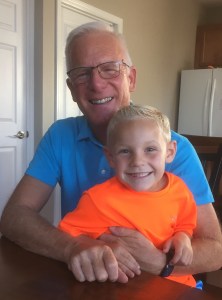
Last week my 8 year-old granddaughter said, “My friends at school say that President Trump is going to build a wall around Mexico.” “Pawpaw, does that mean you can’t go to your office in Mexico City anymore?” “Or if you go there, you won’t be able to come home?”
 Not exactly sure how to explain the situation to her, I said, “No Anna, it means something different.” I told her that I would be fine and my friends and work-mates from Mexico could still visit here. My words seemed hollow and I could see the fear in her eyes and felt certain that my explanation fell short of reassuring her.
Fear. What an ugly experience. And now, so many are living in fear. Fear of deportation. Fear of being denied immigration. Fear of separation from loved ones. Fear of banishment. Fear of death.
What about the fear of terrorism? Fear of unknown or unwanted persons who could do harm to our nation; our cities; our homes. Do we build walls and create borders and more restrictions to keep out anyone who is deemed a threat? And what is the criteria for exclusion? Religion? Skin color? Language? Dress? Who decides?
I think of my own great-grandmother who made the perilous journey alone from her homeland, at only thirteen years of age, to build a better life for herself. My very existence depended on her acceptance into this great nation. Today because of her lack of education and inability to prove herself worthy of finding gainful employment, she would doubtless be denied access.
How can I have hope for a future that seems so dismal? How do I tell my beautiful granddaughter that her unbridled love and pureness of heart may not be enough to cure the evils of this world? I can’t. I won’t.
I need her to believe that good conquers evil; that justice is for all; that hope is still alive. And I will follow her example by loving without question and always looking for good in everyone. I will pray, not just for my friends but for my enemies as well. I will stand up for those who can no longer stand. I will speak for those who no longer have a voice. I will fight racism and sexism at every opportunity. I will respect ALL life.
And I will face another day. A better day. Hope is still alive. I know this because Anna tells me so, without ever speaking a word.
Peace,
Denis
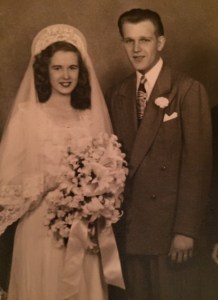 In 1947 an 18 year-old girl named Dot and an (almost) 21 year-old guy named George tied the knot. He having recently completed his stint with the Navy in World War II and she fresh off the farm, these two kids met in August of 1946 and were married the following spring. For him it was love at first sight. For her it took a little convincing but not too much.
 I am blessed to be equal parts of both of them. I’d like to think that I’m the best parts of both of them. I know that I have Dad’s ears and chin and forehead and well, pretty much everything else. But the important parts are less about physical attributes and genetics and more about what has been imparted. Mom taught me how to pray. Dad taught me how to tell a good joke. Mom taught me the importance of cleanliness. Dad taught me the importance of family. Mom taught me how to do math in my head. Dad taught me how to build and fix things (and how to cuss when things don’t build or fix easily). Mom taught me that “early risers” get to enjoy the best part of the day. Dad taught me that watching old movies late at night can be just as rewarding. They both taught me how to love.
 We need the joy of Easter. It is a welcome balm that can ease the pain in our world. I for one love the carnival atmosphere of Easter Sunday services. Kids dressed in itchy new Easter clothes barely able to sit still because of all the candy that they have consumed before breakfast; beleaguered parents who rose before dawn to hide eggs and prepare baskets full of the aforementioned candy for the little darlings; folks who have not been to church in a while looking conspicuously out-of-place; ‘the regular-attenders’ barely able to conceal their annoyance of having to share their pew. We squeeze in and make room for all. And we love and forgive and ask for forgiveness for the times that we have failed to love. The Alleluias return!
 Today I’m writing about how much some kids act like their parents. This “acting-like” behavior is not just genetic imprinting. I believe it’s a learned behavior. I’ve seen it in adoptive families. We all model the behavior we learn as children. Our parents (good or bad) are our first teachers. As adults most of us have experienced the sensation of opening our mouths only to have our mother’s or father’s words come out. It’s almost as if we lose momentary control and someone else takes over – if not our thoughts, definitely our words. Sometimes with regret but always with a sense of astonishment, we hear the words once spoken to us as children and now we are actually saying the same things and WE CANNOT STOP IT.
 And then comes change. Change creeps in and well, changes everything. How many times in my life have I had to adjust to change? Another baby. A lost job. A new home. The death of a loved one. A promotion. An illness. An accident. A marriage. A new grandchild.
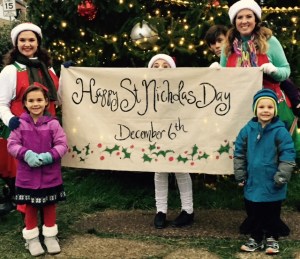 I loved Christmas presents but I knew even as a child that Baby Jesus was always at the center of it. We were raised to believe he would come (again) each year at Christmas. We set our crèche under the tree with all the characters (except baby Jesus of course until Christmas morning). We lit our Advent candles each week. St. Nicholas would come on December 6th and fill our stockings with an orange and some nuts, a peppermint stick and one Hershey® bar (thanks Dad!). At school we would pray and sing carols, collect money for the missions and go to daily Mass. My little Catholic world was secure. And there was abundant joy!
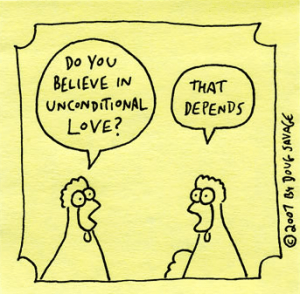 I often find myself questioning whether or not to spend time with someone because of something that was said or done that “rubbed me the wrong way”. There have been times that I judged someone simply because of who their friends are. Worse yet, how about those people I avoid just because of their affiliations with certain political or religious groups? Not to mention the folks that I distance myself from simply because of age, race, ethnicity or income level. My justification – “I don’t hate them; I just don’t really like them.” or “I don’t have anything in common with these people.” or “I already have enough friends.”
 Journeying & Journaling