Throw open the shutters. Spring has arrived! Daffodils and tulips and the dogwood are blooming. Birds are singing. New life is in abundance!
Tomorrow is Easter Sunday, the day in which Christians celebrate Christ’s rising from the dead. As believers, our salvation is ‘a done deal’ if we choose the gift of His redemption. So churches will be filled to capacity.
 We need the joy of Easter. It is a welcome balm that can ease the pain in our world. I for one love the carnival atmosphere of Easter Sunday services. Kids dressed in itchy new Easter clothes barely able to sit still because of all the candy that they have consumed before breakfast; beleaguered parents who rose before dawn to hide eggs and prepare baskets full of the aforementioned candy for the little darlings; folks who have not been to church in a while looking conspicuously out-of-place; ‘the regular-attenders’ barely able to conceal their annoyance of having to share their pew. We squeeze in and make room for all. And we love and forgive and ask for forgiveness for the times that we have failed to love. The Alleluias return!
Baked ham, lamb with mint jelly, hot cross buns, deviled eggs and asparagus will adorn our dining tables. Desserts will be rich and plentiful. And don’t forget the candy, surreptitiously snatched from the kiddies Easter baskets while they’re being distracted by yet another treat left behind by the Easter Bunny. Welcome home Springtime!
Some Christians are bothered by all the focus on the Easter Bunny, feeling that it diminishes the sanctity of Easter. After all what does a bunny that hides eggs and gives candy have to do with our Risen Savior? I’m not sure. But what difference does it make? Easter supplanted pre-Christian spring festivals and it doesn’t make it any less sacred to me.
So I’ll welcome the Easter Bunny to hop into my back garden again this year and hide his (her) eggs and leave behind some treats. I’ll smell the sweet aroma of new flowers and tree blossoms. I’ll love and forgive and ask for forgiveness. I’ll eat some ham and sing my Alleluias. And be thankful for it all.
Peace,
Denis
“Why do you seek the living one among the dead?” Luke 24:5
 Today I’m writing about how much some kids act like their parents. This “acting-like” behavior is not just genetic imprinting. I believe it’s a learned behavior. I’ve seen it in adoptive families. We all model the behavior we learn as children. Our parents (good or bad) are our first teachers. As adults most of us have experienced the sensation of opening our mouths only to have our mother’s or father’s words come out. It’s almost as if we lose momentary control and someone else takes over – if not our thoughts, definitely our words. Sometimes with regret but always with a sense of astonishment, we hear the words once spoken to us as children and now we are actually saying the same things and WE CANNOT STOP IT.
 And then comes change. Change creeps in and well, changes everything. How many times in my life have I had to adjust to change? Another baby. A lost job. A new home. The death of a loved one. A promotion. An illness. An accident. A marriage. A new grandchild.
 Sunday at mass it will be the same priest, the same boring or out-of-touch homily, the same listless liturgy, and sometimes I just want to “phone it in”. I’ll go through the motions but I can’t help but wonder if my time might not be better spent cleaning out a closet or organizing the cabinets in my office. I suppose I could pray while I straighten out my clutter. Isn’t cleanliness next to Godliness or something like that?
 This morning he didn’t think he could make it to school. He pleaded his case but Mom and Dad assured him that he would be okay. They offered him a favorite stuffed animal to take for “rest time” at pre-school (which is apparently a common practice for others in his class). The stuffed animal might offer some security and reminder of home but he refused it in a very adult manner: “No thank you Mommy, there are two reasons I don’t want to take my stuffed animal. First, I don’t want germs from other kids to get on it. And sometimes people play with their stuffed animals when it’s not resting time and our teacher doesn’t like that.” Apparently he knows his limitations.
 Short and sweet can grow tiresome when the rest of the world (or classroom) is tall. My wife has reaching sticks and step stools and similar aids but I’ve heard her say many times that it would be nice just to be “tall enough”. Tall enough to reach the top shelf in the grocery store. Tall enough to buy pants that don’t need to be tailored. Tall enough to do some things without help from the Tall Ones.
 Legend and tradition tell us more: The Three Kings (three gifts were presented but the Gospel never tells us the number of Magi) were named Caspar (or Gaspar), Melchior, and Balthasar. Early Christian art depicts the three men as coming from Europe, Asia, and Africa. And growing up my nativity set at home would show them likewise. Tradition also tells us the significance of the gifts – gold: a gift fit for a king; frankincense: which is burned during prayer; myrrh: which is a perfume most often associated with burial – a foreshadowing of Jesus’s death and suffering. Another tradition (brought to the U.S. by European immigrants) involves writing the initials of the three kings’ names above the main door of the home to confer blessings on the occupants for the New Year. For example, 20 + C + M + B + 16.
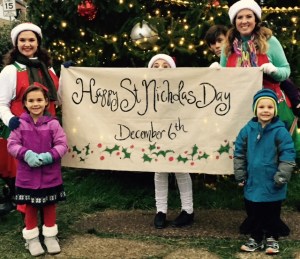 I loved Christmas presents but I knew even as a child that Baby Jesus was always at the center of it. We were raised to believe he would come (again) each year at Christmas. We set our crèche under the tree with all the characters (except baby Jesus of course until Christmas morning). We lit our Advent candles each week. St. Nicholas would come on December 6th and fill our stockings with an orange and some nuts, a peppermint stick and one Hershey® bar (thanks Dad!). At school we would pray and sing carols, collect money for the missions and go to daily Mass. My little Catholic world was secure. And there was abundant joy!
 Journeying & Journaling