Recently we toured the Cahokia Mounds Historic Site. As the largest prehistoric Native American site north of Mexico it once covered about 4,000 acres and included 120 mounds. Today 2,200 acres and 70 of the remaining mounds are protected as a World Heritage Site. It is estimated that during years 1,050 to 1,200 A.D. there were between 10,000 to 20,000 people living in the area.
By the late 1,300s Cahokia was essentially abandoned. Much is lost to history of the peoples and why they left. Ironically the name Cahokia is even a misnomer. The Cahokia Tribe were late arrivals and did not build the mounds. The Mississippian Culture actually built and populated the site during its greatest peak of civilization.
But what of its demise? Why did the peoples leave? Where did they go? Depletion of natural resources; climate change; political unrest are all hypotheses.
Climbing Monks Mound, the largest manmade mound in the Americas (named after French Trappist monks from the 19th century who had absolutely nothing to do with its creation) one experiences the vastness of the site. I couldn’t help but be in awe of what the Mississippians had built. It’s beautiful and at the same time heartbreaking to think that this civilization which must have been so important during its existence has essentially vanished.
I couldn’t help but think about the year we lived in England and toured what seemed like countless abbeys, cathedrals and churches that were essentially abandoned. Most were tourist attractions with little or no worship taking place. Will our churches, mosques and synagogues someday become ruins that future peoples view with mixed feelings of confusion and curiosity?
It’s easy to discount the Mississippians as primitives who had no understanding of God (at least the God of my beliefs) but what of our (my) legacy? Empty churches? Grand buildings with no purpose? Icons and statues to a God who is removed from daily life?
I need to stop only looking for God in institutions and sanctuaries. I need to stop just searching for faith in buildings and books. I find comfort in my traditions and in those comfortable places and in those inspired writings but that is not enough. I must look at my neighbor with compassion. I must look at my loved ones with mercy and forgiveness. I must face myself and embrace my fears and my failures. And love. Above all I must love.
Peace,
Denis
So faith, hope, love remain, these three; but the greatest of these is love. 1 Corinthians 13:13
This morning at Ash Wednesday mass, Monsignor challenged us to do something during Lent this year. Something for others. Fasting and abstaining is all well and good, and self-reflection and self-improvement is always a good thing, but he suggested that doing something for others might make a difference in our homes, in our communities, in our world, but perhaps most importantly in our hearts.
I’m realizing that giving something up is much easier than doing something. Giving up chocolate or alcohol is admirable, but it’s an empty gesture if I remain unkind to others. Prayers are nice but are rendered meaningless if I don’t put a little action behind them.
I need to do something. So here I am, telling myself to get up, get out, and get going! This isn’t easy. And to make it an even greater challenge, today’s Gospel comes with a warning label: Take care not to perform righteous deeds in order that people may see them; when you give alms, do not blow a trumpet before you. What the heck*? (also trying to give up swearing for Lent or at least tone it down a bit) So, I should do something good or give to the poor but do it on the down low? Christianity is hard. Lent makes it even harder.
For me Lent is about trying to try – if that makes sense. I’ll try to DO SOMETHING. I’ll try to GIVE SOMETHING. I’ll try to quit swearing (that’s where the trying to try really comes in).
I used to think that Lent was a time to fix me. But when Holy Week comes, I may not have a spiritual awakening. When Lent is over, I may not feel like a changed man. Perhaps God is just waiting for me to figure that out. My only hope is that God will save me and that I will have the courage and humility to allow it.
My resolution for 2023 is to get rid of some stuff. I started with my home office, got out the shredder and emptied the file cabinet and desk drawers of accumulated, outdated, unnecessary paperwork. Next came the spare bedroom with a closet chockfull of clothes that have “shrunken” or gone out of style in the 10+ years they have been hanging patiently waiting for another outing. On to the basement wasteland of abandoned but once-loved stuff. I’m trying desperately to take a clinical approach with my purging. If we haven’t used it or needed it in the past year or so, it can be sold, donated, trashed or otherwise disposed of. My mantra: “When it doubt – toss it out”.
Turns out that’s easier said than done.
At Christmastime when our grown children were in the house, I encouraged them to remove their treasures. I mean seriously, the Teddy Ruxpin Bear has been waiting to be loved once again for decades. What about all those scouting badges and dozens of neckerchiefs? What about the countless middle-school volleyball and basketball trophies? Even our grandkids have outgrown any interest in their parents’ old toys, dolls and games. Apparently, our kids were insincere years ago when they begged us to never get rid of whatever is in all those boxes of mystery lining our basement walls. I’ve been told that the landfills might be spared the dollhouse furniture, He-Man figures, and Teenage Ninja Turtles via Ebay but that seems like too much effort for too little return. Why won’t my grown children stake their claims on Ebay?
Now in fairness, not all of the mess is the kid’s stuff, but my stuff has more intrinsic value. My three old hammers: one came from my dad, one came from my father-in-law, and the third one is a mystery. My conundrum is that I don’t know which one of the three came from Dad or Pop, and only God knows where the third one came from, so I have no choice but to cherish all three. My wife has similar challenges with some old china, glassware and a trove of “home decor” accessories. So, separating the wheat from the chaff is painstakingly slow. But it’s just stuff.
Letting go of stuff is not easy but it is necessary unless your goal is to be featured on an episode of “Hoarders”. Is that show still on television? I’m usually too busy watching stuff saved in my DVR to watch anything currently being aired – ugh, more saved stuff!
As hard as it is to let go of the physical stuff, letting go of the emotional stuff is even harder. But it’s time to unload that baggage, too. I find I often pack up resentments, disappointments and heartaches in neat little boxes so that I can haul them out, unpack them and fuel my grudges and prejudices. Never forgiving or forgetting any injustice (actual or imagined) that has been inflicted upon me gives me another opportunity for self-righteousness and indignation. Sometimes it so satisfying to be the victim. And nursing those wounds of others’ wrongdoing only serves to make me feel correct and superior momentarily. In the end it just feeds my sadness. It’s exhausting carrying all that crap around.
Jesus invites us to be reconcilers. It’s impossible to be a reconciling presence in my world, my community, my family if I’m angry or resentful. Carrying boxes of hate in my heart just clutters my mind and burdens my soul. So, I have some unloading to do. I have stuff to get rid of. And it’s just stuff.
I grew up with images of Sweet Baby Jesus being born on Christmas day. Sometimes I’m nostalgic for those days of innocence: Jesus’ and mine. In the comfort of my suburban home, I imagined all good girls and boys had the same kind of Christmas to which I was entitled. I was taught that Jesus was born poor and in a stable but, I had no real understanding of poverty or homelessness. Our Christmases were gloriously predictable: Santa would come; cookies would be baked; dinner would be plentiful; family would gather. And plaster Baby Jesus was perfectly happy to stay tucked away in his manger with Mary and Joseph dutifully at his side while we opened our presents.
While playing with my new toys, I would give an occasional nod to Jesus. We would attend Mass and sing our carols and I knew that Christmas was about the birth of Jesus. But my world was small and my understanding of life beyond my family, my neighborhood, and my parish was limited. And I liked it that way. There was security in the bubble that was my young life. Mom and Dad and my brothers and baby sister were all I needed. The messy stuff; the scary stuff; the life outside; was more than my little mind could (or would) comprehend.
Then it happened. I grew up. Life got messy and sometimes scary, but I held on tight to my need for perfect Christmases. I wanted everyone to be happy. “Jingle Bells” would be blaring from my cassette tape player. Reality would be put on hold. As a newlywed I found Christmas to be another opportunity to share our love but with the added stress of finding (and affording) that perfect gift. When our children came along, I tried desperately to give them the Christmas of my youth: warm, secure, loving, with plenty of gifts and a dash of Baby Jesus thrown in for good measure. And we would routinely go in debt to make darn sure that happened. Because no one could be disappointed with a less than perfect Christmas!
They say with age comes wisdom. I’m not sure if that’s true. I think more accurately “with age comes the same mistakes over and over”. And sometimes if we’re paying attention or we get kicked in the head we might actually learn from those mistakes. You can call that wisdom, I guess. At least that’s my wisdom experience.
I mean no disrespect to anyone who needs the image of Baby Jesus at Christmas. I love babies and I think it’s remarkable that our Savior was born an infant. However, Jesus’ humble birth sends a message that for most of my life escaped me. As I’ve aged, I’ve come to the realization that Christmas comes to everyone, not just the happy little families gathered around their tree. I will always cherish my childhood experience of Christmas, but as Christians we are called to have a preference for the poor, the marginalized, the forgotten. “As followers of Christ, we are challenged to make a fundamental ‘option for the poor’—to speak for the voiceless, to defend the defenseless, to assess lifestyles, policies and social institutions in terms of their impact on the poor”. I have some work to do.
But here’s the good news: Jesus comes for all of us! What I need to constantly remind myself is that Christmas comes whether we’re celebrating a beautiful Christmas liturgy or working the graveyard shift at a convenience store. Christmas comes whether the gifts under our tree are beautifully wrapped and plentiful or if they are being given to us by a volunteer at the Salvation Army. Christmas comes if we’re enjoying a sumptuous feast with family gathered or sitting alone at a soup kitchen. Christmas comes while we’re holding our sweet-cheeked grandchild on our lap or holding the hand of a loved who has just received a devastating diagnosis. Christmas comes whether we are celebrating new love or mourning the loss of our lifetime companion. Christmas comes with giggles and joy and with tears and heartache. Christmas comes.
I still strive for those perfect Christmases. The ones where everyone is happy and well fed and sufficiently gifted and loved beyond measure. But now I know to also look for Jesus in the less fortunate circumstances. I try to find Christmas in the hurried shoppers, the beleaguered parents, the refugees searching for a home, the lonely neighbor, the recovering alcoholic, the estranged family member, and that old man that I see in the mirror.
So, my prayer this year is that wherever we find ourselves, we are still able to shout the Good News. Jesus is born! Our salvation is at hand.Whether you’re in a high holy place with a glorious choir singing Alleluia or handing out “Toys for Tots” to children in need; if you are “on top of world” or find yourself lost in despair, hoping for better days to come or pining for days gone by, I hope that Jesus (or whatever/wherever you find comfort at Christmas) touches your heart and lifts your spirits.
May your Christmas this year be perfected by His love.
Denis
The angel said to them, “Do not be afraid; for behold, I proclaim to you good news of great joy that will be for all people. Today a savior has been born for you.”
Sometimes I feel like I’m the ONLY ONE. The only one who gets the joke; who knows the score; who sees the absurdity in a given situation; who uses correct grammar and knows the meaning and proper use of the word exacerbated, which is often how I feel. Being the ‘only one’ can be a lonely place. Why isn’t everyone as intelligent, well-informed, and confident?
Of course, when I think about it (and pray about it) I realize how self-important and misguided I am. At times I choose solitude because I really want to be left alone; to not be bothered by the opinions and needs of others. It’s easy to be uncaring when you remain aloof.
Do you suppose that John the Baptist (the crazy, animal skin wearing, locust eating, hermit) thought that he was the ‘only one’? The only one who knew what was coming? Was he skulking around in the desert because he was disgusted with the callous disregard of others? Maybe. Or did he think that wandering around alone in the desert was a great way to get his message out? I don’t know. But as we prepare for the coming of the infant Jesus at Christmas, John the Baptist reminds us that there is something else coming. We must prepare for the change that Jesus creates; in our world; in our church; in ourselves. While I may feel like ‘the only one’ that is exactly the opposite of the message of hope, peace, love and connectedness that Christ brings to us. I am admonished by the Gospel message.
I need to join humanity. Get dirty. Pay attention. Get involved. Make a difference. Lend a hand. Carry a load. Love. These are not things that I can do alone.
I believe that when I open my heart to others, Christmas will come. In the meantime, I have some valleys to fill and some mountains to tumble. I know that my own arrogance, pride and ‘only one-ness’ need to be made low. And my heart and spirit could use some filling up and straightening out right now.
Then and only then, will I be truly worthy to hold the Christ-Child and be able to encounter Jesus in everyone I meet.
Peace,
Denis
A voice of one crying out in the desert, “Prepare the way of the Lord, make straight his paths.”Matthew 3:3
My daughter shared that on her family’s recent trip to the Grand Canyon her 11-year-old son became concerned with her welfare on one of the trail hikes and took her hand. She’s not sure if he thought that the steep incline might be too challenging for her or if he was worried because she was battling allergies or perhaps, he thought she might be frightened of the heights. Regardless, he held her hand. This is something that this 11-year-old boy doesn’t normally do in public anymore. He’s too big now and too vulnerable to 5th grade peer pressure to be seen holding hands with Mom.
A few weeks ago at church a woman who I know needed some assistance. I know her in the “from church” sense of the word. I know her name and that she was recently widowed and that she had been a teacher years ago, but I don’t really know her well. Still, we’ve always spoken to one another in the polite ‘have a nice day’ kind of way that casual acquaintances do. Lately she has acquired a walker and on this particular Sunday, I helped her retrieve it after Mass. That simple gesture was repaid by a smile and a grasp of my hand and squeeze from her old bony hand. It was a sweet, warm encounter. I wondered as she scooted off how much she must miss the touch of her beloved late husband’s hand.
I lost my Mom nearly three years ago and there is not a single day that goes by that I don’t think of her. Usually, they are happy thoughts and fond memories of the times we shared. Sometimes, I feel the ache of her absence profoundly; I feel her loss in my heart; in my soul; and in my physical being. On those days I am comforted by the memory of one of our last times together. A week before she died, I stopped by to visit, and Mom was on the sofa in the family room. Her pulmonary fibrosis had gotten the best of her that day and she was listless and breathless. We sat side by side on that sofa and she put her hand in mine and we sat there in silence. No words were needed. I remember feeling like a young boy once again being comforted and reassured that Mom was going to be okay. There I was trying to take of her and instead she was taking care of me.
Holding on and letting go.
My grandson held on to my daughter on that canyon hike as she was struggling to let go of the baby boy who is no longer there. He let go of his fear of being seen holding hands with Mom. She is comforted in knowing now he will always take care of her while is she busy also taking care of him.
My friend from church is holding on to her walker and letting go of some of her independence. She is forging ahead in a life without her spouse. And she is blessing those around her who offer her small kindnesses.
My Mom gave me a such a beautiful gift on that day on the sofa together. She gave me hope and peace. As we were holding on to one another she let me know without words that it was time to let go.
Our daughter is a second grade teacher. She loves to teach. And I suppose unless you love it, you shouldn’t do it. The pay is meager and the challenges are plentiful. Still, she is a joy-giver and has an indefatigable spirit and those kiddos will someday remember her as someone who mattered. Because in her classroom they matter. She makes learning fun but she reminds her students that what they do and how they do it is important. School is important and so are they.
Truth is, she’s been teaching her entire life. She taught me how to be the dad of a daughter – which can be pretty daunting for us slow-learners. She taught her brothers a thing or two along the way. And of course her husband and children are devoted followers. She teaches; we learn.
Seeing her welcome her second graders this year brings back thoughts of classrooms long ago. Remembering my apprehension each school year of who my teacher might be and worrying that I might have forgotten EVERYTHING during my summer of freedom from the classroom. What would I do if I couldn’t remember arithmetic or names of the state capitols or something? I remember I would pray to Saint Jude, patron of hopeless cases, for a day or two before school started and somehow miraculously I could write my name in cursive after my summer hiatus.
As an adult I fondly remember favorite teachers; Miss Boerding, my second grade teacher who had a beautiful smile and always smelled nice and was patient and loving. Sister Leandra, who insisted on good grammar and penmanship and told amazing stories, which may or may not have actually been true. Miss Pfaff, geography teacher who instilled in me my love of travel at an early age. Sister Thecla, my high school drafting and graphic arts teacher who was a hoot and made her classes fun while we worked our tails off trying to meet her standards of excellence. Sister Fidesta, high school algebra and geometry teacher who was a force to be reckoned with but always had a twinkle of kindness in her eye.
I’m thankful for my many teachers. When I correct someone’s grammar (in my head) while they’re speaking or become frustrated with their improper sentence structure and lack of punctuation in an email I thank Sister Leandra. As I cringe while someone says, “I’m going down to Wisconsin” (and they’re not coming from Canada) I thank Miss Pfaff. When I study architectural drawings and work on designs for my job I thank Sister Thecla. When I have to be tough but remember to also be kind I thank Sister Fidesta.
Of course, I’ve had countless teachers outside of the classroom as well. My wife is a tireless teacher who has yet to give up on me. My Mom taught me how to pray. I have a workmate who leads me through the perilous journeys of our data system whenever I am lost. I have friends who teach me by their love and devotion and our shared experiences. My grandkids teach me how to operate some of these gadgets in our house that are apparently necessary for survival today. How many remote control devices must one have?
In or out of the classroom I’m always learning. And most days it’s good to get back to school.
Below is a text exchange I had today with our teenage granddaughter. “Teenage granddaughter”. I still hold my breath a little when I say those words. That tiny baby girl who I held in my arms just moments ago is a teenager. But today I got a glimpse of the woman she is becoming: strong and smart and loving and faithful.
Here’s our exchange:
Me: We honor Mary’s parents, Anna and Joachim, as saints. We celebrate the joint feast day of Jesus’ grandparents on July 26th. Their love for one another and for Mary is an example to us of how God calls us to live. They also remind us to honor our own grandparents and to thank them for the blessings they have passed down to us in love. Happy Feast Day Anna! (I have to admit that part about honoring your grandparents was blatantly self-serving but I sent it anyway.)
She:I am greatly blessed to have you and Nana as my grandparents and today I am especially reminded of that. I love you.
Those words: I am greatly blessed… and I love you.
Just when the world seems to be too much to bear. Just when I’m not sure if I’m even fit for humanity. Just when I can’t seem to find a kind word or a kind thought, there she is. My girl. My teenager. She softens my roughness. She calms my restlessness. She looks past my ugliness. She ignores my mean-spiritedness. She digs deep and finds the love and beauty and truth that I sometimes keep buried deep under the angst of everyday living. But she finds it! She lifts my spirit and she soothes my soul.
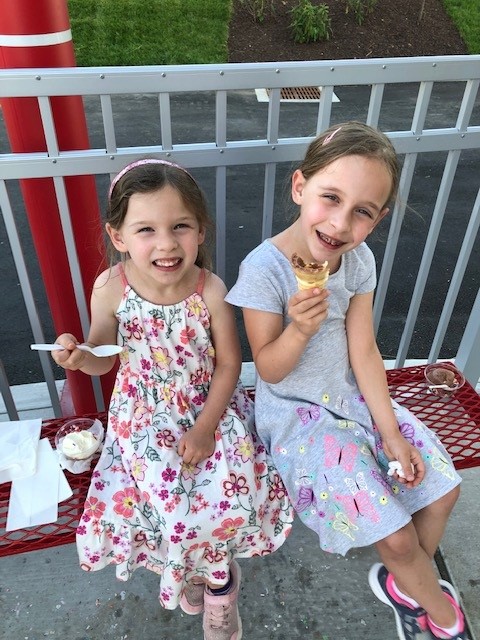
We have two of our granddaughters, aged 5 and 7, staying with us for three weeks this summer. It has been a lot. A lot of fun. A lot of laughs. A lot of ice cream. A lot of laundry. A lot of love. A lot of questions.
You forget sometimes when you are an adult to ask questions. I mean we already know everything anyway, right? What is there to learn? We’ve been there and done that. We stand by our convictions and our restrictions and God help anyone who tries to get us to open our eyes (or minds) to new ideas or experiences. And please don’t make me learn anything new. My brain is old and tired and full.
Sadly, there is a loss of fascination and wonder as you age. And I am guilty of not-wanting-to-know-anything-else! Ignorance is bliss. I don’t have to be responsible for anything if I don’t know how my irresponsibility contributes to the pain or suffering in our world. I believe in God (most days) but there was a long stretch during the Trump administration that made me doubt His (Her) existence. So much hate. So much darkness. So much divisiveness.
But my granddaughters are full of wonder. They ask questions about EVERYTHING. They force me to think about the whys and wherefores. They force me to take off my blinders. Their innocence and joyfulness and energy reminds me that I need to be more mindful of my responsibility as a human being. Their curiosity rekindles my need to better understand what is happening in my neighborhood, my church, my country and my world. I cannot afford to be a silent bystander when there is so much to be done. There is such a need for compassion and love in this world and I can do my small part.
On those days when I curse my fellow humans and stick my head in the sand I will try to remember that my granddaughters desire a better future. I must stay hopeful and faithful. I must keep asking questions. What can I do to help others? Why is there so much hate in our world? When will we learn to love one another? Where can I find hope and strength? How do I improve myself, my neighborhood, my church, my country and my world?
Nadia Bolz-Weber wrote a prayer that includes:“And lead us not into temptation but deliver us from evil. Deliver us from the inclination that we do not have evil in our hearts. Deliver us from religious and national exceptionalism. Deliver us from addiction and depression. Deliver us from self-loathing. Deliver us from self-righteousness. Deliver us from high fructose corn syrup. Deliver us from a complete lack of imagination about where you are in our lives and how you might already be showing up. Deliver us from complacency. Deliver us from complicity.“
As I read her prayer I realize that I too need to be delivered. I need to be delivered from my self-assuredness and pride and I need to start asking some questions. I need to ask the ones that are especially hard to ask – like where is God in my life? I need to learn to be patient with myself as I search for those answers. I also need to let go. I need to stop carrying the weight of anger and resentment. I need to unload those obstacles that consume so much of my energy and brain activity. Then perhaps I can wonder and wander. And maybe even carry someone else’s load for awhile. After all, isn’t that what we’re supposed to do?
Peace,
Denis
The link below will take you to Nadia Bolz-Weber’s complete prayer
My father-in-law was a thoughtful and loving man. He was more comfortable as an observer than a participant in most situations, but when he spoke it was always worth my while to listen. I’m more of doer and a talker (too much of a talker, according to some) and I was often humbled by his quiet wisdom.
We lost him last week. And I’m certain that the angels welcomed him to heaven.
Pop was a father, grandfather, great grandfather and father-in-law. Nothing made him happier than being surrounded by family. We are all better persons for having had him in our lives.
He grew up poor in Southeast Missouri. He lived a hard life as a kid. He earned pocket money killing rats in the cotton and watermelon fields as young boy. He lived in his grandparents’ home when his mother couldn’t afford a place of their own but he never complained about his upbringing. He never voiced any regrets. He was grateful for all that he had in life.
In many ways he was ahead of his time. Unlike many men of his generation men he wasn’t afraid to do what was considered “woman’s work” and he often did the grocery shopping, would clean the house on occasion, do laundry and could prepare a meal if necessary.
He enlisted in the Air Force and then had a 40 year career with American Airlines but he never forgot his humble beginnings. What I remember most is that he never uttered an unkind word about anyone. He never looked down on anyone. It didn’t matter where you lived or what you looked like, he accepted you as you were. I never once heard a racist or anti-Semitic word or phrase pass his lips. He truly believed that all men and women were created equally. And he lived his life that way.
He taught my wife how to be a person of dignity and more importantly how to afford dignity to others. Since his passing she has wished that she had asked him more questions – about his life as a boy; his time in Korea in the Air Force; his love affair with her mother; his career; his grandparents and great grandparents; his hopes and his dreams. But if she had been able to ask all those questions, I know in my heart that he would have likely shrugged and said, “I have no regrets. I’ve lived my best life. And as a bonus I got you as my daughter.”
Pop would have done anything for any of us, but he didn’t like being fussed over himself. The night he died we let him get some rest. His health had been declining rapidly and he had had a fitful time the night before. We went into another room and reminisced about happier times. When we went to check on him the second or third time, we realized he had found his way home.
Our son commented later about Grandpa not wanting to be hovered over. He said, “It was just like him to sneak off while no one was watching.”
And so it was…
Peace,
Denis
I have finished the race; I have kept the faith. 2 Timothy 4:7