Precious Blood

As an associate member of The Most Precious Blood Community, this week I had the privilege of visiting the Precious Blood Ministry of Reconciliation located on Chicago’s Southside in the Back of the Yards and Englewood neighborhoods.

When PBMR was established in 2002 it mostly served young people who were re-entering the community after incarceration or were still incarcerated. Entering society after spending several years in prison brings several hurdles. PBMR believed that through relationships and strong community they could offer hospitality and accompaniment to those in need.

Today the ministry has grown to include all those impacted by violence.
PBMR works to create safe spaces for youth where they can grow and play apart from the violence, poverty, and trauma of their daily lives. Mentors offer youth opportunities to learn healthy life skills and just enjoy being a kid through community activities.

Many young adults in this community face tremendous challenges as they navigate street violence, incarceration, and family conflict. Case Managers accompany young adults as they work toward achieving their goals, whether it means visiting them in prison, going into their homes, or accompanying them to court. They identify needs and acquire resources to help youth heal and move forward.

The Women Forward Initiative seeks to engage women in activities that unite, heal and strengthen each participant in their physical, emotional, financial and spiritual development. It is dedicated to accompanying women and families impacted by the effects of violence and incarceration. They work with girls and women, especially mothers who have faced tragedy.
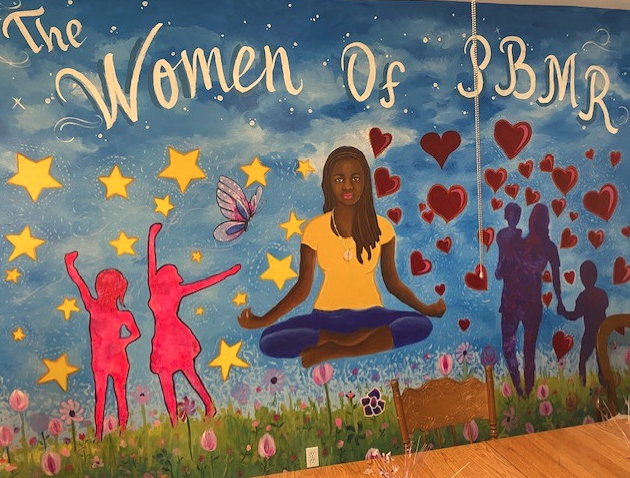
Meeting one of the mothers who was profoundly impacted by violence has changed my notion of Precious Blood. I’ve always thought of the “Precious Blood” as Christ’s Blood and of course, it is. But my understanding of precious blood has now been challenged to consider that our blood is also precious, that each of us has Christ’s saving blood running through our veins. While this mother retold the story of losing her son to violence, she refused to say he had passed away or that he had died, she wouldn’t even say that he had been killed. Her words: “My son was murdered.” She refuses to describe his death in any other manner. He was murdered. He had been shot in the face. When I had an opportunity to speak with her privately, I thanked her for her honesty. We cried and hugged and grieved as I suppose only parents can do. It felt as though she was hugging her son as she embraced me. I couldn’t help but think of my own boys, and I desperately wanted to feel their touch at that moment. She told me that she had been given the honor of holding her boy in her arms the day he was born and the honor of holding his bloody head in those same arms on the day he was murdered. I have no words to adequately describe her strength. This mother has amazing energy, faith, joy and love. I am humbled by her spirit. I cannot even imagine how she carries on as she gives back to the community that murdered her son. She works at the center helping other families navigate life after unimaginable devastation, loss and heartache. She provides radical hospitality to all whom she encounters as she honors the son who was lost.

And his precious blood.

Peace,

Denis

Learn more about the important work that PBMR does: https://www.pbmr.org/
Feast Day

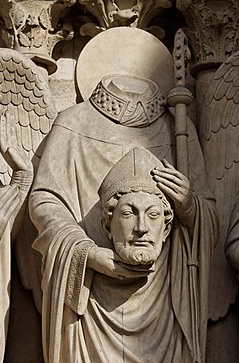
Today is the Feast Day of St. Denis. Feast days in the Church seem archaic and arcane. Perhaps that’s why I like celebrating them. They’re a reminder that our Church is ancient and mysterious and somehow still enduring.

According to legend Denis was Bishop of Paris in the third century and was martyred by beheading. He is said to have picked up his own head and walked six miles, preaching a sermon the entire way. Also, Denis is the patron saint of headache sufferers, frenzy and strife. This is not surprising considering that six-mile trek while carrying his own severed head!

Of course, I admire the “saintly” saints who prayed and fasted and gave up all worldly possessions to follow Jesus’ call, but Denis was a badass who defied his Roman persecutors! Not only was he tough but he was cool. Let’s call it grace under pressure – extreme pressure.

I keep celebrating feast days amidst the ugliness and uncertainty in our world today. When I forget that love should be my guiding principle and I refuse to accept all my sisters and brothers, I believe that I am turning my back on God.

Julian of Norwich, a 14th century mystic, wrote, “God is all that is good. God has created all that is made. God loves all that he has created. And so, anyone who, in loving God, loves all his (or her) fellow creatures.” Julian was a woman who lived during the bubonic plague and still found joy in all creation. I am comforted by the knowledge that our Church is ancient and universal and that Julian’s wisdom still speaks to me today. I am reminded that I continue to make mistakes; to exclude; to blame; to punish. I need the example of the Saints to ask for God’s forgiveness. I sometimes get weary from lugging my own head around – full of certainty and self-righteousness, but often lacking compassion.

How many times in history have we nearly undone the gift of Church that God has given us? I wish all Christians would remember that we are the Church. I believe that there is room at the table for us all. We can honor those who have come before us and thank God for the wisdom they have shared. We can pray for those who will follow us and show them that love is never a mistake.

A feast day is as good a time to do both. Jesus loves saints and sinners.

Saint Denis pray for me!

Peace,

Denis

Humbled

It might seem absurd, but I’ve always prayed that my children and grandchildren would have a humbling experience in their lives. Please understand, I don’t want them to have to deal with overwhelming pain or suffering or heartache, just a little “kick in the butt” that will help them remember that they are not invincible.

I think we all need to be reminded that we are not truly self-made, but we are the product of our genetics, our raising and our beliefs. Above all, we are treasured creations of God. Accepting that we can make mistakes (even big ones) and are forgiven is a blessing and a comfort. Understanding that we have people in our lives who will help pick us up and/or help us pick up the pieces should console us even in our darkest hours.

Confidence is a good thing. Intelligence is valuable and skill-mastery is crucial, but we should never forget that love is essential to our existence. When I think of the times (there have been many) that I have been humbled, I always remember the love that carried me through. Humility allowed me to accept the kindness and forgiveness of those I have disappointed. Of course, it has always been harder to forgive myself. Like most of us, I am still a work in progress. I’m learning to accept those setbacks, disappointments and mistakes, and to forgive myself. And I am humbled by God’s grace.

In his book “God’s Voice Within”, Mark Thibodeaux writes:

“I may have failed miserably at some task. I may be confused about where I am in life or angry about something that has happened. But if my anger motivates me to push for justice or truth, if my confusion leads me to trust in God more than myself, if my failure or sadness leads me to reach out to the people in my life then perhaps those negative experiences aren’t so negative after all.”

Perhaps we can find some joy in our mistakes. If being humbled allows me to reach out to the people in my life and accept their understanding, their help, their forgiveness, and their love, I am truly blessed. If my humility makes me more empathetic to others misfortune or opens my eyes to injustice and cruelty in our world, then perhaps I can be an instrument of healing and comfort.

Don’t get me wrong. I’m not going out of my way to screw up. I can do that without even trying. But I can accept my failings and be humbled by the love of God through those who allow me to fail and still love me.

More importantly, I can be someone who accepts others’ failings and comforts them and loves them as they are humbled. So, go on and climb those mountains, take on this big world, and be the best that you can be. But if you are humbled, you should know that you are never alone.

Peace,

Denis

Be A Light

Yesterday was Pentecost and when I think of Pentecost, I usually think of the Apostles with little flames on top of their heads. But there is so much more going on. Granted, fire resting on the top of your head is certainly an attention-getter. God chose Pentecost to share the Holy Spirit with the Apostles and perhaps God needed the fire to get their attention. Regardless, it seems like God pulled out all the stops, and the fire thing was just the beginning.

God also allowed all the Apostles to speak and be understood in a multitude of languages to all who were assembled. Now that’s a showstopper! Sometimes I think I miss this part of the Gospel because I’m so focused on the flames.

When the time for Pentecost was fulfilled, they were all filled with the Holy Spirit and began to speak in different tongues, as the Spirit enabled them to proclaim. Now there were devout Jews from every nation under heaven staying in Jerusalem. At this sound, they gathered in a large crowd, but they were confused because each one heard them speaking in his own language. They were astounded, and in amazement they asked, “Are not all these people who are speaking Galileans? Then how does each of us hear them in his native language? We are Parthians, Medes, and Elamites, inhabitants of Mesopotamia, Judea and Cappadocia, Pontus and Asia, Phrygia and Pamphylia, Egypt and the districts of Libya near Cyrene, as well as travelers from Rome, both Jews and converts to Judaism, Cretans and Arabs, yet we hear them speaking in our own tongues of the mighty acts of God.” Acts 2:1-11

I find comfort in knowing the Apostles spoke to “the assembled” in their native languages. It reminds me again that diversity in our faith makes us stronger. At times I also find it challenging. We do not need to look the same or love the same or speak the same language or worship in the same manner. God has shared the Holy Spirit with each of us. And my duty is reach out to those unlike myself. God is asking me to afford dignity and respect to all those I encounter. It’s easy to love those folks who look and act like me, but true Christianity means offering peace and reconciliation to those who do not fit so neatly into my idea of a perfect world.

Theologians explain the Trinity as the profound love the parent (God) has for the child (Jesus) which then manifests itself as the Holy Spirit and becomes the third person of God. We were all children once and some of us have even been fortunate enough to be parents, so maternal/paternal love is something we all know. We can feel it but can’t easily put it into words. Sometimes that love is comforting; sometimes it is painfully absent; often it is heartbreakingly bittersweet; it is always overwhelming. We have all felt it and we all need it.

When I pray to the Holy Spirit, I am surrendering myself to God’s will. It can be frightening. It can create uncertainty. It requires trust. It forces me to let go. Like parenthood, it’s the scariest, best thing that I will ever know.

I could use a little fire, metaphorically speaking. I’m not saying I need a flame on the top of my head. But I could be a light.

Peace,

Denis

Did You Hear the Latest News?

Each and every day there seems to be more and more troubling news. The senseless war in Iran. The skyrocketing gas prices. Cost of living and healthcare costs increasing dramatically. Cuts to environmental protection. Deportations. Redistricting plans. Supreme Court decisions. Political retributions. James Comey’s indictment. The White House Ballroom. The vitriol social media comments coming from the President. And his name and face being plastered on everything from our passports to our currency.

It is exhausting. And perplexing.

The political divides have never been greater in my lifetime. There is no longer public discourse. Just finger-pointing and name-calling. Fear mongering and villainization of our enemies is commonplace. Mostly there is hatred. And ugliness.

Oh, yes, and let’s not forget to pull God into it as well. Afterall, if God is with us who can be against? Some of the most hateful rhetoric comes complete with God’s “seal of approval”. Is God really on our side against the Iranians? Does God want us to “blow up the whole country” and destroy their civilization? Does God truly want children separated from their parents who are seeking a better, safer life to be imprisoned for a misstep in the immigration process? Does God want us to punish our perceived enemies or anyone who would disagree with us?

If you listen to many of our political leaders, it seems so. If I listen to some of my neighbors, it seems like God is on the side of racism, marginalization, hate and destruction. If I listen to some of the folks I worship with each week, it appears that as long as abortion remains mostly illegal, we can just rationalize all the rest of the shitty stuff.

In his book “God Plays a Purple Banjo”, S. James Meyer challenges me. He writes: “How do we measure up? If we profess our love for God without practicing love for neighbor, we might be religious but not always spiritual. If we receive Holy Communion in the church but don’t become Holy Communion in the world, we might be religious but not spiritual. If we pray for peace but harbor hatred, pray for forgiveness but judge others, or pray for the poor while profiting from systems that create or exploit poverty, we might be religious but not spiritual.”

Jesus never told us to hate our enemies. Jesus never told us hurt one another. Jesus never asked us to fight.

Instead, Jesus said: “Blessed are the merciful, for they will be shown mercy. Blessed are the clean of heart, for they will see God. Blessed are the peacemakers, for they will be called children of God.“

Friends, how do we measure up?

Peace,

Denis

Hippity, Hoppity, Easter’s on its way!

The origins of the Easter Bunny are unclear, but he is mentioned in early German writings. The first edible Easter bunnies appeared in Germany in the 1800s and were made out of sugar and pastry. As a kid I often wondered what the Easter Bunny had to do with eggs. Polish folklore has the Virgin Mary offering eggs to the soldiers guarding Christ on the cross, as she begged them to be merciful, her tears left stains on the eggs. Eggs and bunnies and candy. There are so many conflicting images that all seem to converge at Easter in some pastel menagerie with chocolate and jellybeans thrown in for good measure.

Easter

I’ve read commentaries by some Christian writers complaining about the commercialization of Easter; how Easter is demeaned by the purchase of candy and greeting cards, etc. Easter-related spending in the United States is expected to reach about $25 billion in 2026, on everything from Easter candy to new clothes. But wasn’t Easter originally a pagan feast to celebrate spring? Painting and dying eggs pre-dates Christianity. It seems that early Christians just conveniently supplanted what was already a festival. Sort of, “Hey, we already have a party – let’s make it about Jesus!”

As a Christian, I’m not really bothered that Easter was formally a pagan feast day. I’m equally undisturbed with the Easter Bunny sharing the day that celebrates the Resurrection of Jesus Christ. If we find new life in Christ, why not celebrate the new life around us? And if you’re not a Christian, I still hope that you can enjoy a dyed egg and a chocolate bunny (or whatever means springtime to you). According to the National Confectioners Association’s survey 87% of people create an Easter basket for their kids. This just makes for happy kids. It needn’t diminish the importance of Easter. To the contrary, it should emphasize the joy we share. Why not “wear your Easter bonnet, with all the frills upon it?”

For Christians this is our Holy Week. This is the most sacred time in our Church calendar. We celebrate and remember the passion and death of Jesus. We begin this week with Palm Sunday and continue through Holy Thursday and Good Friday, as we journey with Jesus to the cross. On Saturday at the Easter Vigil, we celebrate His rising anew. Through His death and resurrection, we are saved!

This year I’ve decided that instead of being annoyed with the secularization of Easter, I will embrace the world that God has given us. Whether I encounter those who are thankful for a Savior or folks who are just thankful for spring weather, I will try to share their joy. As some of my friends celebrate Passover and others are looking forward to a long weekend, why create conflict? Instead of looking for something to be angry about or focusing on our differences I will try to bring peace and reconciliation to those I meet.

I believe that God created a world big enough for all of us. So I’ll be singing Alleluia on Easter and later if I spy a bunny in my garden or a jellybean should find its way to me, so much the better.

Peace,

Denis

He is not here, for he has been raised just as he said. Matthew 28:6


Ever Ancient – Ever New

During this school year, my wife and I have been invited to join the monthly “Grandparents’ Mass and Rosary” at our grandson’s high school. Any grandparent who can attend is welcomed. Each gathering consists of a mass, the recitation of the rosary and a grandparent’s blessing. After mass and rosary, we are then joined by our grandson for a brief visit. What a joy and blessing to share time with him at his school and get to take a peek into his world.

The word rosary comes from Latin and means a garland of roses, the rose being one of the flowers traditionally used to symbolize the Virgin Mary. Most people, Catholics and non-Catholics alike, are aware that a rosary is a strand of beads and has some prayerful significance. The Catholic Church considers the rosary a “sacramental”. Other examples of sacramentals include blessings, holy water and medals. They are merely intended to enhance the spiritual life of the faithful and may have more cultural significance for some than others. Sacramentals are not a requirement of our Church, but they are traditions with which many find comfort. The beads on a rosary signify different prayers, but the “Hail Mary” is the most prominent. Typically, it is repeated 53 times while praying a rosary. All Catholic school children learn this prayer, and most can recite it from memory. It’s an ancient prayer imploring Jesus’ mother Mary to pray for us and all those in need of God’s mercy, especially those near death. 

I love the “Hail Mary” because it’s easy to remember, but mostly because it harkens back to the days when most people were uneducated and yet were still able to implore God’s mercy with this simple prayer. I imagine my ancestors praying the same words that I repeat today. Recently, while attending mass and holding my dad’s rosary, I felt generations of believers joining me in my devotion. I thought of their journeys of faith, and I want to believe that they were praying with me and for me. All of us together asking Our Blessed Mother to be with us in our times need and to intercede on our behalf.

So today I pray for my grandchildren, my children, my wife, my siblings, my friends and all those who have gone on before me. There is comfort in knowing that my simple prayer is being joined by countless others through the centuries. It is powerful, this prayer that is ever ancient – ever new!

Truth be told, I always thought of praying the rosary as kind of an ‘old person’ thing. I guess the time has arrived.

Peace,

Denis

The angel Gabriel was sent from God to a town of Galilee called Nazareth, to a virgin betrothed to a man named Joseph, of the house of David, and the virgin’s name was Mary. And coming to her, he said, “Hail, full of grace! The Lord is with you.” Luke 1:26-28

Saint Joseph Pray for Us

Today is the Feast of Saint Joseph. As a father, I have a strong devotion to Joseph – the patron saint of all fathers. I have been blessed with three incredible children. I realize that I’m not in their league in terms of intelligence, ability, and achievement. And yet, God decided to bless me with these three.

I rely on Saint Joseph to help me. He knew the overwhelming responsibility of fatherhood. He understood that the love of a father is so strong and yet at the same time so tender it cannot be described in mere words. He certainly must have felt ill-equipped, at times, to deal with Jesus. I could write volumes about my ineptitude as a father. I take for granted that my children understand that they are in my heart so deeply that every day I am blessed by their very existence. But I’m not sure I always show them by my actions. Sometimes no matter how hard I try – I fail. I do the wrong thing. Or I behave unkindly. Or forget to say, “I love you”. God gave me Saint Joseph to reach out to when I make a mess of things.

We know little about Joseph. We know that he had doubts. We also know that he said yes. He protected Mary and Jesus. Joseph is often depicted as an old man. But I believe Joseph was young when Jesus was born like I was when my kids came along. A worker. A teacher. A companion. A dad. Frightened but courageous. Ill-prepared but undaunted. Beleaguered but unrelenting. He must have had a sense of humor. I’d like to think that Jesus laughed at Joseph’s “dad jokes”.

My prayers always include my children and my grandchildren but while asking God to protect them, I sometimes forget to thank God. So, thank you God! You did a great job creating these beautiful humans. God, thanks for letting me have a hand in it, too. And thanks especially for giving me St. Joseph as a model of fatherly love, patience, and devotion.

Peace,

Denis

Saint Joseph, pray for us (and especially me)!

Wholly Holy

How often have I rejected the idea of holiness? How often have I considered myself less than “the faithful” who seem to pray constantly? Those blessed folks who attend mass regularly (even daily); who adorn their homes with sacred objects; who never cuss; who know all the rules (and follow them).

Does their piety annoy me or shame me? Perhaps both.

In 2023, Pope Francis wrote “To be holy does not require being a bishop, a priest or a religious. We are frequently tempted to think that holiness is only for those who can withdraw from ordinary affairs to spend much time in prayer. That is not the case. We are all called to be holy by living our lives with love and by bearing witness in everything we do, wherever we find ourselves.”

Being holy needn’t mean you lose yourself. Instead, I believe it means that you should be your authentic self (warts and all). I can bear witness. I can choose to love. I can do that even when I feel shitty or disgusted. I can pray even when I feel hopeless and lost. Perhaps that’s when my prayers are most sincere. I know that I am not alone. My prayers for the people that I love bring me peace and comfort in knowing that God is watching over them. My prayers for people that I don’t know helps me feel connected to them and gives me strength and hope for a better future for all God’s children. I am also humbled in the knowledge that others are praying for me.

At times I feel overwhelmed with life. At times I only see the evil and violence in our world. But then I feel the love and holiness of others. The natural, messy, unscripted holiness that surrounds me every day. I am enveloped in that love. And I am saved.

God didn’t create me to hate me. I know that I can never be a pious, super-holy, choirboy. It’s just not me. I might not kneel as often as I should, but thanks to the saints in my midst, I am wholly holy.

Peace,

Denis

He saved us and called us to a holy life, not according to our works but according to his own design and the grace bestowed on us in Christ Jesus before time began. 2 Timothy 1:9

Giving Up for Lent

Recently I read, “This Lent I’m just going to give up.” It was written tongue in cheek and intended to be humorous, but it struck a different chord in me.

Some Catholics feel tremendous pressure to “give up” something to honor Jesus’ ultimate sacrifice. Or to “do something” honorable or charitable or extra-holy. It doesn’t do me much good to have ashes smeared on my forehead and then turn a blind eye to the mistreatment and suffering of so many in our nation.

Most of us needn’t go back more than a few generations to find ancestors who immigrated to the United States. In my own family we are descendants of fur traders who journeyed from France to Canada and ultimately to the Midwest around the time of the Revolutionary War, as well as Germans seeking political refuge in the 19th century. Some came seeking fortune and wealth. Some were fleeing poverty, political injustice, or religious persecution.

In November 2000 the U.S. Catholic bishops published “Welcoming the Stranger Among Us: Unity in Diversity”.  The document states, “The presence of so many people of so many different cultures and religions in so many different parts of the United States has challenged us as a Church to a profound conversion so that we can become truly a sacrament of unity. We reject the anti-immigrant stance that has become popular in different parts of our country, and the nativism, ethnocentricity, and racism that continue to reassert themselves in our communities.”

That was over 25 years ago and still many in my parish community consider immigrants as dangerous and undeserving and unwanted. Seldom, if ever, does any message come from the pulpit in regard to welcoming the stranger among us. Rarely is there any acknowledgment of the brutal treatment by our government of immigrants and our responsibility as Catholic Christians to open our hearts and minds to our sisters and brothers. Our clergy often preach that we should be pro-life but usually that seems to only mean pro-birth. Welcoming those fleeing for their very lives is apparently too messy to deal with, let alone to preach about. Our congressman, a Roman Catholic, has built his career on hateful misogynic rhetoric and our local Church leaders remain silent.

Fortunately, I have great friends and spiritual advisers who understand that God’s love for us is indeed for ALL OF US. They are examples of unconditional love. They are models of true Christianity. I find hope and strength in their presence. Their actions speak louder than words. And their songs fill my heart.

Often the work of true Christians is done quietly; humbly, with little fanfare. We can continue to pray, but it’s time to make some noise. We need to put our words into action. We need to care for the poor and welcome strangers. We need to put those in power on notice. We need to comfort those wounded by their draconian policies. We must remember that all life is precious.

Speaking up and speaking out might be risky and more of a sacrifice than giving up chocolate or alcohol or saying extra prayers this Lenten Season, but I refuse to give up, and I refuse to be silent.

Peace,

Denis

Lord, when did we see you hungry or thirsty or a stranger or naked or ill or in prison, and not minister to your needs? Matthew 25:44