Author Joelle Chase writes, “Mary is an archetype of the feminine in all of us—man or woman—sometimes hidden or subverted, but always present and available, inviting us to embrace what appears small, unimportant, embarrassing, weak. She knew her strength, the miracle of her body that would knit Life out of God’s seed.”
That’s a powerful statement and it runs counter to the image of a helpless, hapless, teenage Mary who is poor, afraid, pregnant, unwed and uncertain. Mary said yes. Not because the angel told her that she should, but because she knew her own strength, her potential and her power.
Mothers are powerful! Ask any woman who has cared for a sick child; wept for the loss of life; fought for her child’s acceptance; guarded her offspring without flinching; celebrated joy and comforted heartache; loved unconditionally. All while saying “yes”.
Ask any man who loves a woman and he will tell you that mothers are powerful. When men can’t – women do. When fathers fail and flail; mothers take charge. No one loves like a mother; fights like a mother for what is right; dreams beyond her own capabilities like a mother. All while saying “yes”.
God could have come to earth on cloud or from a lighting bolt. Jesus could have appeared “poof” out of nowhere. But instead he was born to a woman as an infant. God chose to be loved by a mother. Jesus shared in the joy of being truly human; of being cradled in a mother’s arms; to know her strength and her tenderness.
We can all learn from Mary’s “yes”. Women and men alike. Yes to truth. Yes to courage. Yes to strength. Yes to gentleness. Yes to peace. Yes to love. Yes to life. Yes to God.
Peace,
Denis
“Behold, I am the handmaid of the Lord. May it be done to me according to your word.” Luke 1:38
Last Sunday our Associate Pastor gave us two words to reflect on: quiet and slow. On that first Sunday of Advent, he suggested that we approach this Christmas Season quietly and slowly. Considering the usual hustle and bustle of this time of year that is a challenge for many of us. For me it seems nearly impossible.
Let me explain.
I’m loud. Really loud. I was born the third son in a family of four siblings. In our house you didn’t wait for your turn to speak, you just spoke louder than your brothers. My sister is the youngest and she’s pretty loud, too. Our father was loud (even when he thought he was being quiet). My wife reminds me all the time that I don’t know how to whisper. And I know that I speak over other people. I try to suppress this tendency but most times I fail. So apparently, I’ve inherited my dad’s inability to be quiet.
I’m fast. My mother was fast. In fact, her entire family moved at a rapid pace, and I’ve inherited that trait, too. Why spend your whole life just moseying along? I’m often restless and find no pleasure in ‘taking my time’ to do anything. We have stuff that needs to get done! My dad used to joke that “Rome wasn’t built in a day, because no one in your mother’s family was on the job site”. Of course, he told that joke loudly.
I know that Advent is counter cultural. It should be a time of quiet reflection. There’s plenty of time to wrap the presents and trim the tree and raise a glass of cheer. I need some time for meditation and prayer. Time to quiet my soul and prepare the way for Christ’s coming into my life. But it goes against my very nature.
Quiet and slow. These attributes are not my strong suit. When I’m with a prayer group and we have ‘moments of silence’ and quiet reflection I begin to twitch. I can only hear the ringing in my ears. My mind jumps around to the various and assorted IMPORTANT THINGS that need to be done (quickly!). What was our focus? Something Jesus-y. When can we begin talking again? Oh Christ! I mean oh Christ, please help me!
Quiet and Slow. I like a challenge. But quiet and slow?
This Advent, when I get caught up in all my busyness, I will listen for God’s voice shouting for me. I imagine God, as my Mom, all those years ago when I was boy out playing with my friends, shouting for me to come home.
Wisdom shouts in the street, She lifts her voice in the square; At the head of the noisy streets she cries out; At the entrance of the gates in the city she utters her sayings. Proverbs 1:20-21
Come home! And then I can light my Advent wreath. One flame at a time.
Saint Paul urges us to give thanks in all circumstances. Sometimes that’s a tough nut to crack.
Years ago, my spirituality group was encouraged to list our blessings and to reflect on what matters most to us. I was the only one who didn’t mention God. Not that I didn’t think that God was important, I just didn’t single him (her) out. Instead, I chose to list experiences for which I was and will always be thankful. In retrospect, I realize that God’s hand is in all of it. That’s kind of how God and I operate. We tend to sneak up on one another. I’m not a “God is My Co-Pilot” kind of guy. I’m more of a “Hey God, you still out there?” “Remember me?” “Help me!”“Wow God, thank you!”kind of guy. And God is like, “Yeah, I got this.”“And you’re welcome”.
So, I thank God for all my blessings: My beautiful wife, who never gives up on me, who keeps me grounded and makes me a better man; my kids, who never grow tired of me and who remind me that I did my best even when I was running on empty; my grandchildren, who never cease to amaze me and who allow me to see into the future through their love, energy, devotion, and kindness; my siblings and my cousins, with whom I share a history and who have never abandoned me. I am thankful for my family.
I am thankful for everyone that I’ve met on this journey of life. Especially those persons with whom I can bare my soul. We carry one another’s burdens, share one another’s joys, wipe away one another’s tears, and celebrate one another’s triumphs. We live in an imperfect world, but we are perfected by the love that we share. Bad things happen, but those things do not have to define who we are. We measure our worth in the joy we find each day. I am thankful for my friends.
My prayers of praise and supplication and thanksgiving often feel like fleeting thoughts (never fully formed or well-articulated). Still, I believe that God listens to my prayers – poorly formed and selfish as they may be. I pray and God listens. I cry and God hears me. I try and God accepts my humble efforts. I am thankful for my faith.
When I think of all the goodness in my life, at times I feel undeserving. But mostly, I am humbled. Why have I been so blessed? How can I begin to thank God for all I have been given? Who am I to have received so much? I am thankful for God’s mystery.
This Thanksgiving, I will rejoice again for all that is good (and try to understand and accept the not-so-good stuff, too). I will give thanks today and continue to work on the ‘always’ part.
And I will keep on singing.
Peace,
Denis
Rejoice always. Pray without ceasing. In all circumstances, give thanks. 1 Thes 5:16-18
It’s hard to find grace these days. There is so much anger in our world. Our nation’s politics have become poisonous. So much cruelty inflicted on innocent people. So much hate in the name of righteousness. I often feel desperate and frightened. I fear for my grandchildren and what the future holds for them.
Our congressman just stated on the House Floor, referring to his fellow citizens across the aisle: “they literally will kill those with whom they disagree, just as their predecessors—leftists Marx, and Stalin, and Lenin, and Pol Pot, and Fidel Castro—did.” He was ratcheting up more hate and distrust between our political parties instead of representing the people in his district. Apparently, Bob Onder, a self-proclaimed Pro-Life Catholic has shamefully chosen ugly rhetoric instead of bipartisanship. So much for respecting all life as sacred. Sadly, we have a president who behaves likes a petulant child. I suppose our congressman is doing his best to emulate Trump’s behavior.
On these worst days I become cynical and morose. I throw my hands in the air and exclaim WTF!
But then I encounter the angels in my life. And I realize that I am not alone in my pain and worry and despondency. Last night while watching a particularly sappy moment in a movie my wife reached out and held my hand. That touch restored my soul once again. I was reminded of a poem that she shared with me 50 years ago. I have returned to it many times in the ensuing years.
Help from above; unfailing sympathy; undying love. Being afraid, crying out in pain, needn’t be a sign of weakness but of surrender. This week Pope Leo addressed a crowd at St. Peter’s Square with these words:
“Jesus teaches us not to be afraid to cry out, as long as it is sincere and humble. A cry is never pointless if it is born of love, and it is never ignored if it is delivered to God. It is a way to not give in to cynicism, to continue to believe that another world is possible.”
So, instead of wringing my hands and cursing the future. I will hope for a better day and pray for the courage to hold on until it arrives. And I will remember that there is no justice without compassion, no joy without sorrow, no peace without pain. So, bring on the rain!
Red-green color blindness, also known as deuteranopia, is the most common type of color vision deficiency. It affects roughly 8 percent of the world’s population. It occurs when a person has an impairment in red cone or green cone pigment perception. People with this condition tend to confuse purple, blue, green, orange, and red.
Color blindness is hereditary. It is passed from a color-blind father to his daughter who becomes a carrier of the genetic material but not color blind herself. She then has a 50 percent chance of passing the genes to her son. Females can be born color blind as well, but it requires a color-blind father and mother who is a carrier and the percentages of carrying to the child are greatly reduced. Therefore, deuteranopia predominately affects males.
I am color blind. And so is my grandson.
Most of my life, especially in my career, I have kept my color blindness a secret. In architectural millwork it’s not helpful for your client to realize that you have no idea what color the finishes are that you are presenting to them for approval. When asked my personal opinion, I would usually say something like, “I agree with you, it does look a little too mauve” then make copious notes to share with my staff who could interpret what the hell mauve might be. All the while my heart would be racing knowing that I couldn’t actually pick up a red ball in a green lawn to save my soul. Did my fraudulent confidence conceal my deceit? Seems to have worked.
My color blindness is more of an inconvenience than a disability. I have a loving wife who helps dress me and decorates our home. I have developed coping skills (red is always at the top of traffic lights). Blue is my favorite color because it is one that I see well. Not so sure about aqua, turquoise, periwinkle or lavender. Turns out those aren’t really blue. A fun game is when someone asks, “What does green look like to you?” My response: “I only see what I see.”
Lately I have been wondering if I am blind about things that have nothing to do with color. Do I “onlysee what I see”? Do I turn a blind eye to the suffering of others? Do I ignore those who are discriminated and disenfranchised? Have I developed coping skills that allow me to ignore the evil and chaos in my own community? Do I allow my fraudulent confidence to conceal my deceit?
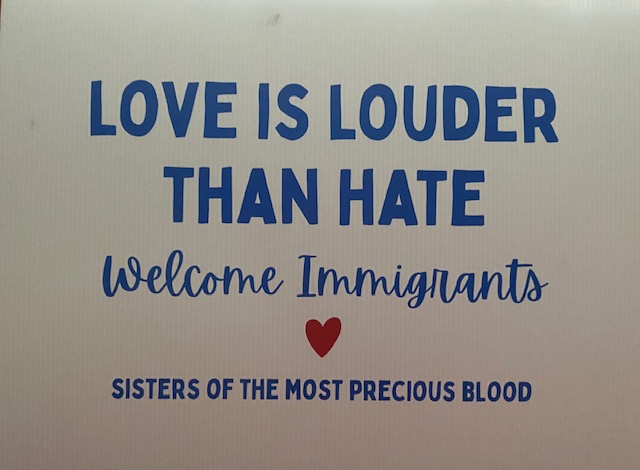
I am an associate member of a lay community of religious Sisters. We are Partners in Mission. We proclaim to be working for peace and reconciliation in our families, communities, country and world. Often, I fall short of that goal. I judge without knowing the circumstance of others. I condemn without understanding the hardships they might be suffering.
Recently, I have been blessed with some opportunities to ‘see true colors more clearly’. My granddaughter is volunteering at a food pantry. I have had the joy of joining her on a few occasions. Watching her loving devotion to the clients she serves has humbled me and reminded me that God works through all of us. God can even use me, if I open my eyes and my heart.
I attended a peaceful “Hands-off” rally where concerned citizens joined together to voice our protest against current administration policies. Most of the passersby were supportive but some, who could have easily ignored us, decided to offer hand gestures and obscenities. I was encouraged to see that democracy is still alive. And I realize that those individuals are entitled to express their opinions as well.
My grandson was awarded a scholarship to the high school he will be attending this fall. He was awarded the Outstanding Service Scholarship for his volunteerism to his community. I suppose he is ‘seeing true colors more clearly’ too.
When Cardinal Robert Francis Prevost stepped onto the balcony of St. Peter’s Basilica as the new Pope Leo XIV, he said “Peace be with you all! Dear brothers and sisters, these are the first words spoken by the risen Christ, the Good Shepherd who laid down His life for God’s flock. I would like this greeting of peace to resound in your hearts, in your families, among all people, wherever they may be, in every nation and throughout the world. Peace be with you!“
I am living with my color blindness and praying to see the true colors in others more clearly.
Recently there was a Medieval Fair in Oklahoma where my son and his family live. While driving past the fairgrounds our youngest granddaughter caught a glimpse of a sign that read, ‘Swords and Shields’ and declared that that was something she would love to have. Her hopes were dashed when my son said, “You are not getting a sword and shield!” Undeterred, she declared, “Looks like I’m going to have to take this into my own hands!” I’m not certain how an eight-year-old with no financial independence was going to manage purchasing the aforementioned sword and shield, but I admire her pluck. Personally, I would have honored her request, but I was reminded, once again, that parenthood requires discipline and denial.
Pondering Gwen’s resolve, I began thinking of the many times I have been denied and have remained silent. How often have I just accepted “no” as an answer? How often have I acquiesced to others’ policies and opinions? How many times have I witnessed fellow humans being dealt with unfairly but lacked the courage to speak up in order to ensure my own safety and privilege? How often have I chosen to “go along, to get along“?
It’s hard today to not become discouraged with our government and the chaos that we are being subjected to. Whether we are personally suffering or witnessing the suffering of those we love, our world is fraught with injustice. As Christians, we are all called to speak out against injustices when we see them and yet our pulpits often remain silent in the face of discrimination against immigrants, the disabled, minorities, elderly, and LGBTQ members of our society. Sometimes my frustration, hopelessness and anger are met with tears.
In his book, The Tears of Things, Richard Rohr writes, “Grief and sadness are doorways to understanding life in a non-egocentric way. Tears come from both awe and empathy, and they generate even deeper awe and deeper empathy in us. The sympathy that wells up when we weep can be life-changing, too, drawing us out of ourselves and into communion with those around us.”
So, I will let my tears fall but I also will stand up, speak up and say ‘yes’ to the naysayers. I will challenge the silent enablers. I still have a voice, a vote, a conscience, and a faith that tells me to care for the most vulnerable in our society. Gwen gives me courage. I’m taking things into my own hands. I will peacefully protest. I will continue to write to my senators and congressman. Most importantly, I won’t let my fears and tears keep me from speaking out against injustice.
As we enter Holy Week, let us remember that Jesus’ suffering and death is not in vain, instead, it is a profound expression of love for humanity.
Peace,
Denis
She stood behind Jesus at his feet weeping and began to bathe his feet with her tears. Luke 7:38
Each Lenten season I make an effort to become more prayerful, more tolerant, more forgiving. I always fall short of my goal. I try. I fail. And I try again. I recently read a meme that made me truly laugh out loud and then it almost immediately hit me over the head. It wasn’t funny at all. I went from laughter to discomfort to sorrow as I realized that this message was for me: “I can’t believe it’s been a year since I didn’t become a better person”. It went from, “ha, ha, you’re a jackass.” to “hey, you really are a jackass!”. A startling reality that requires change.
It occurred to me that Lent isn’t about change, it is about changing. It’s a verb. It’s an action. For some of us (me) changing is slow and painful and tedious and must be repeated over and over. I have to empty my heart of the anger, hate, and perceived injustice that I’m lugging around to make room for love and forgiveness.
I have to let go of my self-righteousness and my judgement of others. That’s a tall order. I’m really good at judging others. I can tell just by looking at some folks that I don’t like them. I preach tolerance but usually I find that I am often intolerant of others. If their political ideology or their worldview doesn’t align with mine, I want nothing to do with them.
I have to also let go of my pride, hurt, disappointment, and failure. I suppose we’re all guilty of holding on to painful experiences in our lives. How often have I allowed the unjust actions of others to keep me from fully loving them? How long have I carried hurt in my heart for the wrongs inflicted by others? Whether it was a past employer or an unkind neighbor or a friend or family member, it weighs me down when I can’t let go of the offenses. Worse still, is the pain that I carry for the times I have hurt others.
Forgiveness is about changing. First, I must own the hurt, the pain, and the disappointment. And then I must forgive the aggressors, especially when the aggressor is me. If I believe that God forgives me, why can’t I forgive others? And if I believe that God forgives me, why is it so hard to forgive myself?
Lent is a good time to “up” my game. Try to change. Try to forgive. Try again. Try harder. Fail. And repeat. And to remember that “I can’t believe it’s been a year since I didn’t become a better person”. And to thank God for the grace to keep trying.