 Growing up in the Midwest, my world was pretty small. Growing up Catholic and attending parochial schools made my world even smaller. To say that my life was insular is an understatement. It wasn’t that I didn’t want to know more – I just didn’t know anything else. Everyone that I knew had a mom and a dad; went to mass on Sunday; lived in a modest house; played in one another’s backyards; had a crucifix and pictures of President Kennedy and Pope John XXIII somewhere in their home; and were mostly happy (at least on the outside). I’m glad that I grew up and out and away from that life but I still remember my childhood with nostalgia. Some things haven’t changed but many things have. I believe that I have.
When I reflect on where I came from and where I am today, I become more aware of the tremendous chasm between what once was and what my life is now. I’ve lived in England. I work in Mexico. I’ve traveled the world. I have friends in England, China, Mexico, Canada, France, The Philippines and The Netherlands. I have strolled through castles in Scotland and Germany. Toured museums in Paris, Madrid and Rome. Walked down cobblestone streets in England and France. Prayed in temples, churches, abbeys and cathedrals in London, Strasberg, Mexico City, Zhujiajiao, Heidelberg and Amsterdam. As an adult I’ve had experiences that I couldn’t even imagine as I child. Today I live only a few miles from where I was born but my world is so much bigger. I respect where I’ve come from and how my upbringing formed my conscience and my beliefs but I am grateful for the experiences of this life that have expanded my horizons.
Last month I joined my manufacturing team from Mexico City on a trip to China. We were touring factories in Shanghai to give the team from Mexico some insight into successful practices being employed there. We were entering the offices of one facility and my good friend and business associate from China stopped in front of a statue of Buddha that is prominently displayed in his lobby. He asked if any of us had a coin. A member of my team from Mexico pulled a peso out of her purse. She was asked to place it on the statue of Buddha, which she did. It was explained to us that this simple act would bring peace and good luck to us and to our friend from China. I couldn’t help but think of all the statues of Our Lady of Guadalupe that I have encountered in nearly every factory, employee lounge and public place in Mexico. Of course my friends from Mexico honored the request because they are so familiar with devotion to Guadalupe. Buddha in many ways is looked upon the same way in China. His image is everywhere and perhaps is dealt with somewhat superstitiously, as are images of Guadalupe sometimes in Mexico.
But on that day, at that time, the connection was real. It’s not often in business that I have a spiritual awakening. Placing the coin on Buddha wasn’t just some hocus-pocus good luck nonsense. I may have grown up in a small town in the Midwest and my childhood experiences may have been limited but here I was in China with my friends and co-workers from Mexico sharing this moment. We weren’t arguing over political or religious differences. None of us were intent on proving our practices or our beliefs were the best. Instead we were reaching out and embracing one another’s cultures. It was done with respect and humility. We had all come from different places but that day we were focused on our similarities not our differences. And I believe that God was pleased and we were all blessed.
Peace,
Denis

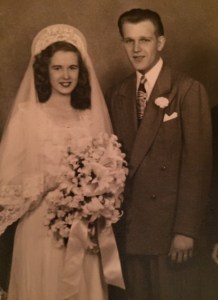 In 1947 an 18 year-old girl named Dot and an (almost) 21 year-old guy named George tied the knot. He having recently completed his stint with the Navy in World War II and she fresh off the farm, these two kids met in August of 1946 and were married the following spring. For him it was love at first sight. For her it took a little convincing but not too much.
 I am blessed to be equal parts of both of them. I’d like to think that I’m the best parts of both of them. I know that I have Dad’s ears and chin and forehead and well, pretty much everything else. But the important parts are less about physical attributes and genetics and more about what has been imparted. Mom taught me how to pray. Dad taught me how to tell a good joke. Mom taught me the importance of cleanliness. Dad taught me the importance of family. Mom taught me how to do math in my head. Dad taught me how to build and fix things (and how to cuss when things don’t build or fix easily). Mom taught me that “early risers” get to enjoy the best part of the day. Dad taught me that watching old movies late at night can be just as rewarding. They both taught me how to love.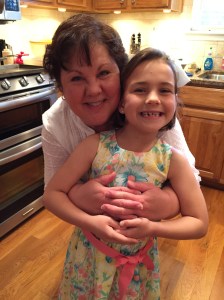
 We need the joy of Easter. It is a welcome balm that can ease the pain in our world. I for one love the carnival atmosphere of Easter Sunday services. Kids dressed in itchy new Easter clothes barely able to sit still because of all the candy that they have consumed before breakfast; beleaguered parents who rose before dawn to hide eggs and prepare baskets full of the aforementioned candy for the little darlings; folks who have not been to church in a while looking conspicuously out-of-place; ‘the regular-attenders’ barely able to conceal their annoyance of having to share their pew. We squeeze in and make room for all. And we love and forgive and ask for forgiveness for the times that we have failed to love. The Alleluias return!
 Today I’m writing about how much some kids act like their parents. This “acting-like” behavior is not just genetic imprinting. I believe it’s a learned behavior. I’ve seen it in adoptive families. We all model the behavior we learn as children. Our parents (good or bad) are our first teachers. As adults most of us have experienced the sensation of opening our mouths only to have our mother’s or father’s words come out. It’s almost as if we lose momentary control and someone else takes over – if not our thoughts, definitely our words. Sometimes with regret but always with a sense of astonishment, we hear the words once spoken to us as children and now we are actually saying the same things and WE CANNOT STOP IT.
 And then comes change. Change creeps in and well, changes everything. How many times in my life have I had to adjust to change? Another baby. A lost job. A new home. The death of a loved one. A promotion. An illness. An accident. A marriage. A new grandchild.
 Sunday at mass it will be the same priest, the same boring or out-of-touch homily, the same listless liturgy, and sometimes I just want to “phone it in”. I’ll go through the motions but I can’t help but wonder if my time might not be better spent cleaning out a closet or organizing the cabinets in my office. I suppose I could pray while I straighten out my clutter. Isn’t cleanliness next to Godliness or something like that?
 Journeying & Journaling